PacketDetective
PacketDetective – Network Traffic Investigation
Scenario
In September 2020, the SOC detected suspicious activity from a user device flagged by unusual SMB protocol usage. Initial analysis indicated a possible compromise of a privileged account and remote access tool usage. Three PCAP files were provided to trace the attacker’s methods, persistence tactics, and goals. --- ## Tooling - Wireshark - Protocol Hierarchy Statistics - Conversations view
Investigation Findings
PCAP 1 – SMB Authentication and Initial Access
Protocol Analysis
Using Wireshark’s Protocol Hierarchy (Statistics → Protocol Hierarchy) revealed that SMB accounted for the majority of traffic with a total of 4406 bytes transferred.
 Compromised Account Identification
Filtering for NTLMSSP authentication:
Compromised Account Identification
Filtering for NTLMSSP authentication:
ntlmssp.auth.username 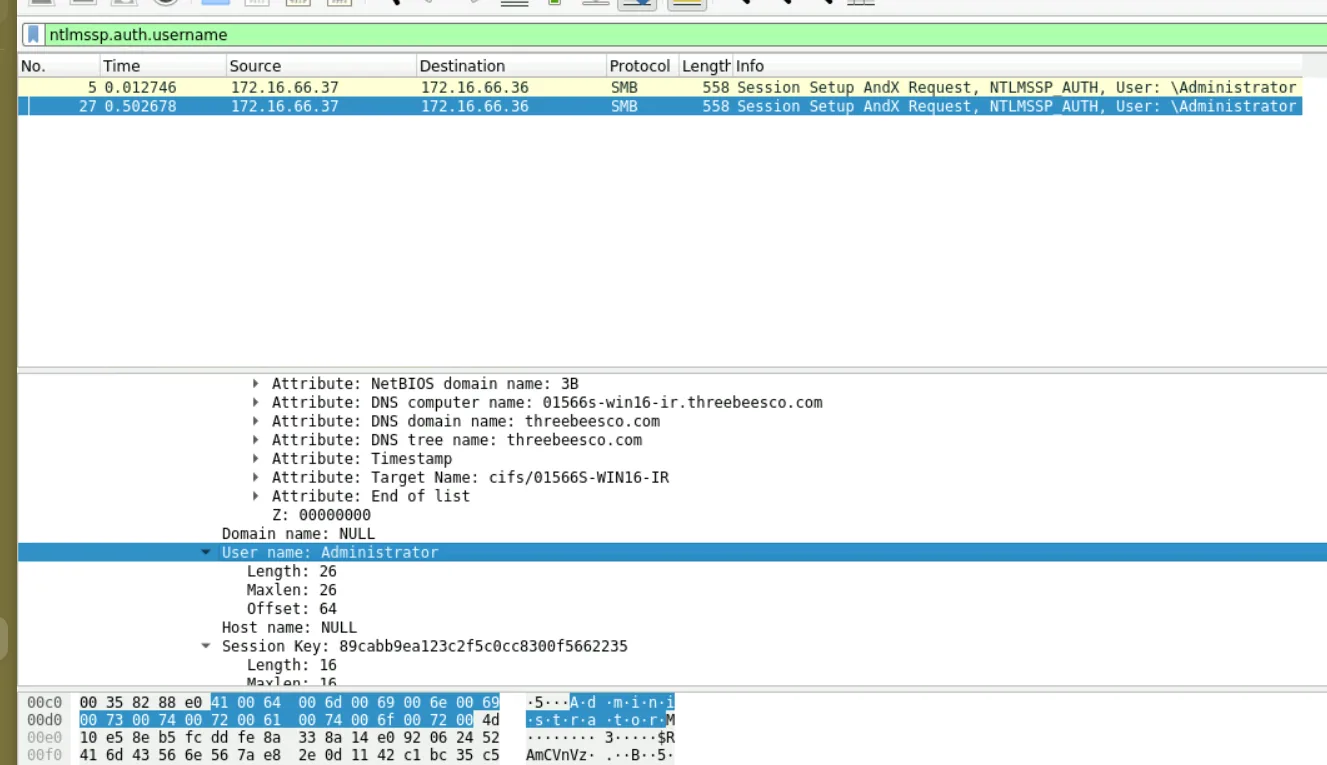 Revealed the
 Administrator account authenticating from 172.16.66.37 to 172.16.66.36 — confirming a privileged account was compromised.
Attacker IP: 172.16.66.37
Event Log Tampering
Searching packet details for create revealed an eventlog file access attempt. The attacker attempted to clear the Windows Event Log at:
2020-09-23 16:50 UTC
This is consistent with MITRE T1070.001 – Indicator Removal: Clear Windows Event Logs.
PCAP 2 – RPC Lateral Movement via Named Pipe
Named Pipe Identification
Filtering with smb && ip.addr == 172.16.66.37 and investigating RPC/DCOM traffic, expanding OxidBindings → StringBindings revealed a named pipe binding:
\\01566S-WIN16-IR[\PIPE\atsvc]
atsvc is the Windows Task Scheduler service — confirming the attacker used RPC over named pipes to interact with Task Scheduler for lateral movement (MITRE T1053.005).
Communication Duration
Using Statistics → Conversations and filtering ip.addr == 172.16.66.1 && ip.addr == 172.16.66.36 the duration of communication between the two hosts was 11.7247 seconds.

PCAP 3 – Persistence and Remote Execution
Secondary Username
Filtering with
ntlmssp.auth.usernamerevealed a second non-standard username: 3B\backdoor — indicating the attacker established a backdoor account for persistence (MITRE T1136).
 Remote Execution via PsExec
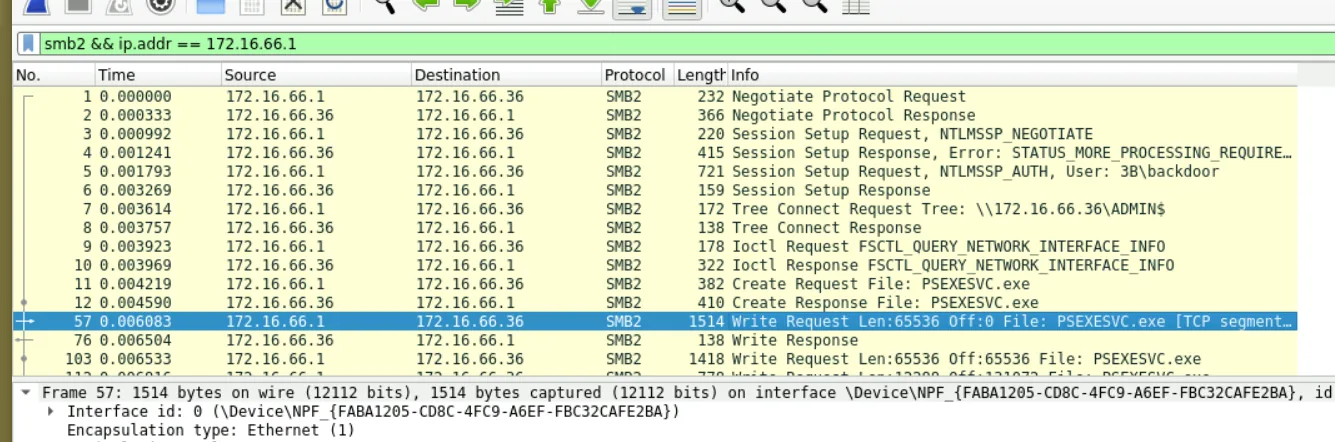
Filtering with
smb2 && ip.addr == 172.16.66.1revealed the attacker writing PSEXESVC.exe to the target — confirming use of Sysinternals PsExec for remote process execution (MITRE T1569.002).
IOCs
| Type | Value |
|---|---|
| IP | 172.16.66.1 |
| IP | 172.16.66.37 |
| username | administrator |
| username | backdoor |
| file | PSEXESVC.EXE |
| timestamp | 2020-09-23 16:50 UTC |
Conclusion
The attacker compromised the Administrator account via SMB, used RPC over named pipes to interact with the Task Scheduler service, attempted to clear event logs to cover their tracks, and established persistence through a backdoor account before executing remote processes via PsExec.
I successfully completed PacketDetective Blue Team Lab at @CyberDefenders! https://cyberdefenders.org/blueteam-ctf-challenges/achievements/inksec/packetdetective/
#CyberDefenders #CyberSecurity #BlueYard #BlueTeam #InfoSec #SOC #SOCAnalyst #DFIR #CCD #CyberDefender