RansomedTrust - Lynx
Scenario
On April 30, 2026, a multinational organization operating across two trusted Active Directory forests was paralyzed within hours. Encrypted files surfaced across workstations, file servers, and domain controllers; ransom notes flooded every shared folder; and a defaced desktop wallpaper appeared on every reachable system.
Initial triage uncovered a forgotten Linux development web server that had been public-facing and unpatched for years. The host carried a second network interface wired directly into the internal corporate network and sat completely outside the SIEM’s monitoring scope, giving the attacker a silent bridge between the internet and the internal estate from which the rest of the intrusion was launched.
It is unclear how the attacker obtained the initial domain credentials used from that pivot, but evidence is consistent with an LLMNR / NBT-NS poisoning attack staged from the same Linux host. Note that legitimate users reach internal hosts through a sanctioned jump box at 10.10.6.205; any interactive session originating elsewhere should be treated as anomalous.
You have been provided with Splunk telemetry from both forests and a copy of the recovered ransomware binary. Reconstruct the attack timeline from the first authentication anomaly to mass deployment, then statically analyze the binary to expose attacker tooling and the family lineage of the deployed payload.
Executive Summary
A Lynx ransomware affiliate bridged the internet and the internal estate through a forgotten, dual-homed Linux dev server sitting outside the SIEM, harvesting a low-privilege domain credential via LLMNR/NBT-NS poisoning and using it to RDP onto the internet-exposed beachhead host. From there the actor enumerated forest trusts and AD objects, staged a macro-laced Office lure on a public file share, and phished an HR user into executing a dropped binary. Local privilege escalation came through a writable service binary flagged by winPEAS and overwritten to land SYSTEM, after which LSASS was dumped to recover a privileged domain account validated against the domain controller. The actor then layered AS-REP roasting, Kerberoasting, process-hollowing persistence, lookalike Domain Admin accounts and a commercial RMM service, cracked a Kerberoasted service credential, and sprayed it across the forest trust into partner.local. With cross-forest Domain Admin secured, Lynx was mass-deployed via Impacket’s psexec.py over ADMIN$ to every reachable host in both forests; static analysis of the recovered binary confirmed an authentic mid-2024 Lynx sample, exposing its developer PDB path, suspicious crypto/network imports, and the base64-embedded ransom note.
Artifacts
- Splunk telemetry (both forests) — Windows Event Logs and Sysmon ingested under the
XmlWinEventLogsourcetype → query in Splunk Search & Reporting - Recovered ransomware binary —
lynx.exe(162 KB, PE32) → triage in DIE, header reads in CFF Explorer, imports/strings/debug in PEStudio, disassembly in IDA, note decode in CyberChef
Sourcetype note: The Security channel and Sysmon both land under the bare
XmlWinEventLogsourcetype (~6.7M events) rather than a:Microsoft-Windows-*suffix. Field names follow XML-ingested conventions (IpAddress,TargetUserName,Logon_Type,TicketEncryptionType). Set the time picker to All time
Initial Access
Q1 — The first hands-on RDP session into BEACHHEAD originated from inside the network. The successful logon record names both the source IP and the user account. Provide both.
The scenario hands you the structural anchor: the jump box at 10.10.6.205 is the only sanctioned interactive source, and the dual-homed Linux dev server is the silent bridge. Filter for the first remote-interactive logon into the beachhead and the anomalous source falls out immediately: sourcetype=XmlWinEventLog EventCode=4624 | sort _time, then narrow to Logon_Type=10 against BEACHHEAD via the sidebar. The earliest hit sources from the Linux pivot, not the jump box, carrying a low-privilege business-unit account — exactly the profile of an opportunistic LLMNR/NBT-NS poison rather than a targeted credential grab.

Tip: The account name is your authentication identity for the entire early Discovery phase — every
net/SharpHound/nltestaction runs under it until privilege escalation.
Q2 — After establishing the RDP foothold, compromised hosts repeatedly fetched offensive payloads from a single internet-facing staging server. What is its external IP address?
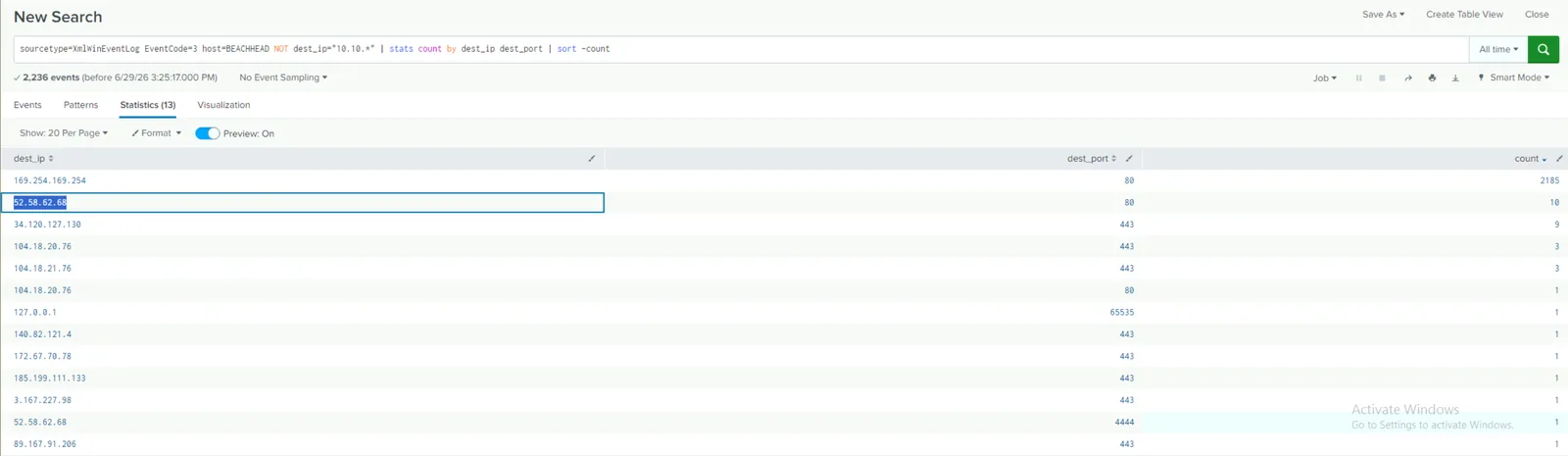
Pivot to outbound Sysmon network connections from the beachhead and strip the internal ranges: sourcetype=XmlWinEventLog EventCode=3 host=BEACHHEAD NOT dest_ip="10.10.*" | stats count by dest_ip dest_port | sort -count. One external address dominates, repeated across multiple hosts over the life of the intrusion — the staging server. The connections cluster on a non-standard high port, the first signal that this is attacker C2 rather than ordinary web traffic.
Discovery
Q3 — To map the full organization, the attacker enumerated forest trust relationships using a native Windows binary. What was the full command executed?
Trust enumeration on a two-forest target is the obvious first move, and it leaves a clean process-creation record. Filter beachhead process creates for the native trust-discovery LOLBin: sourcetype=XmlWinEventLog EventCode=1 host=BEACHHEAD | sort _time | table _time, CommandLine, Image. The nltest invocation with its trust-enumeration switch is the artifact — a single native binary call that hands the actor the corp.local ↔ partner.local relationship.

Q4 — Following the trust enumeration, the attacker collected Active Directory objects data into a timestamp-prefixed archive in a system temp directory. What is the full path of the file produced?
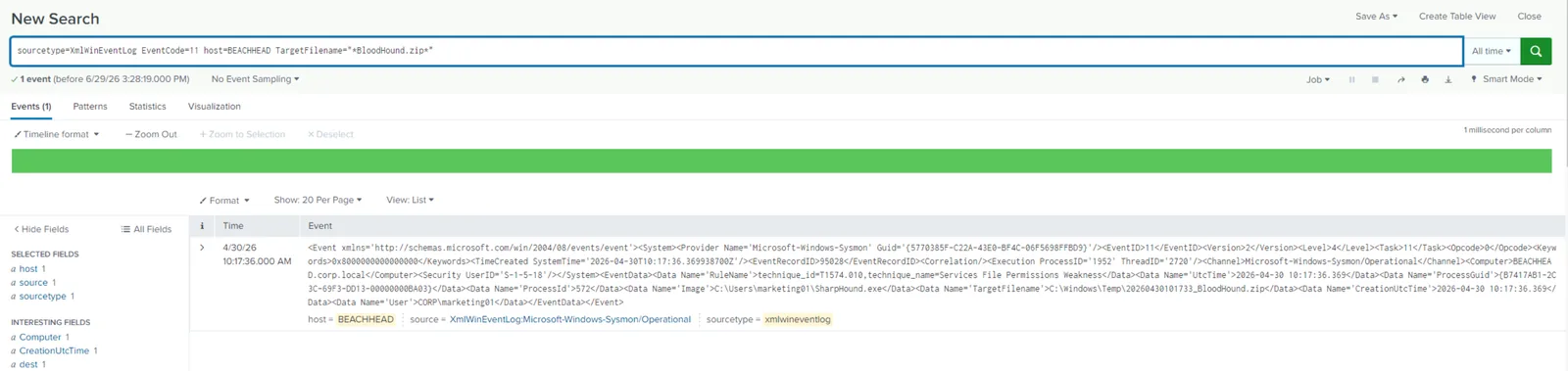
Trust discovery into AD object collection is a natural sequence, and the collection tool here is SharpHound. The process create shows the invocation — "C:\Users\marketing01\SharpHound.exe" -c Default --outputdirectory C:\Windows\Temp\ — but the question wants the produced file, not the directory. SharpHound writes its zip on completion, so pull the FileCreate event a second later: sourcetype=XmlWinEventLog EventCode=11 host=BEACHHEAD TargetFilename="*BloodHound.zip*". The timestamp-prefixed filename is the tool’s own completion stamp baked into the output name.
Gotcha: The process-creation command line only gives the output directory (
C:\Windows\Temp\). The answer is the full filename, which only exists in the FileCreate event — the 14-digit prefix is the completion timestamp, one second after the SharpHound launch.
Q5 — While exfiltrating the AD-collection archive over an external SMB share, the attacker leaked credentials in plaintext via the command line. What username:password pair was exposed?
The same beachhead process timeline, scrolled forward past the SharpHound output, shows the exfil: a net use mapping the external staging share with inline credentials. Continue sourcetype=XmlWinEventLog EventCode=1 host=BEACHHEAD | sort _time | table _time, CommandLine, Image and the net.exe use \\<staging>\share /user:... line exposes the pair in cleartext on the command line. The actor first attempted the share on a non-default port before falling back to the standard mapping — a useful breadcrumb for the C2 port question later.
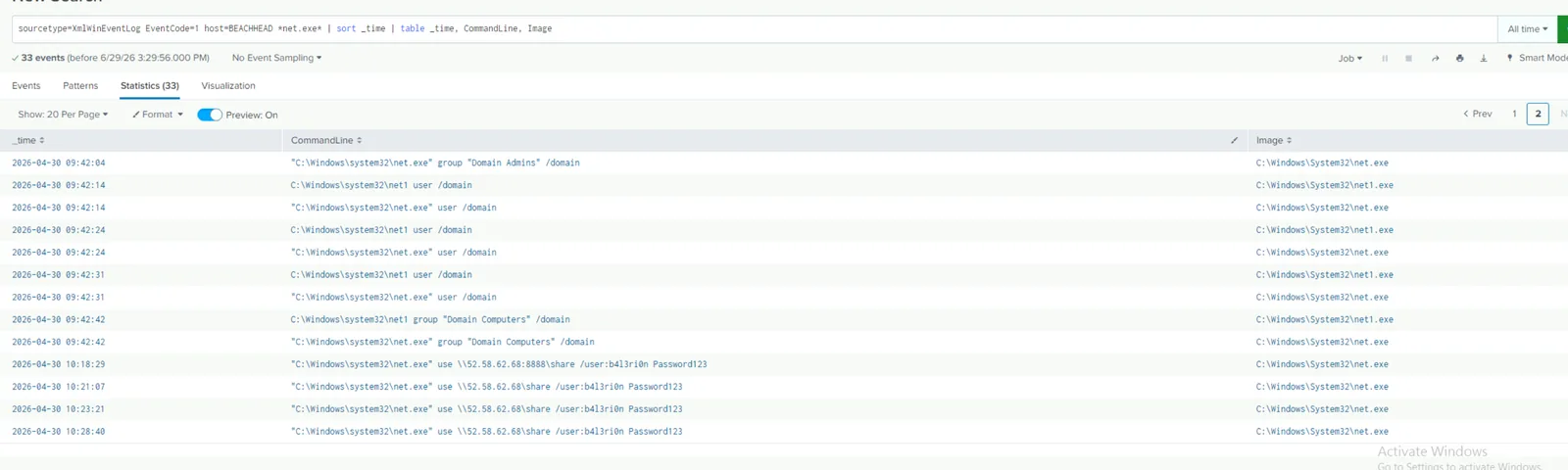
Hint: The same command repeats several times with a port variation on the first attempt — note the alternate port for later cross-referencing against the C2 callbacks.
Internal Phishing & Initial Execution
Q6 — With share-write access confirmed during enumeration, the attacker dropped a macro-enabled Office document on a file server share to phish an internal user. What is the filename?
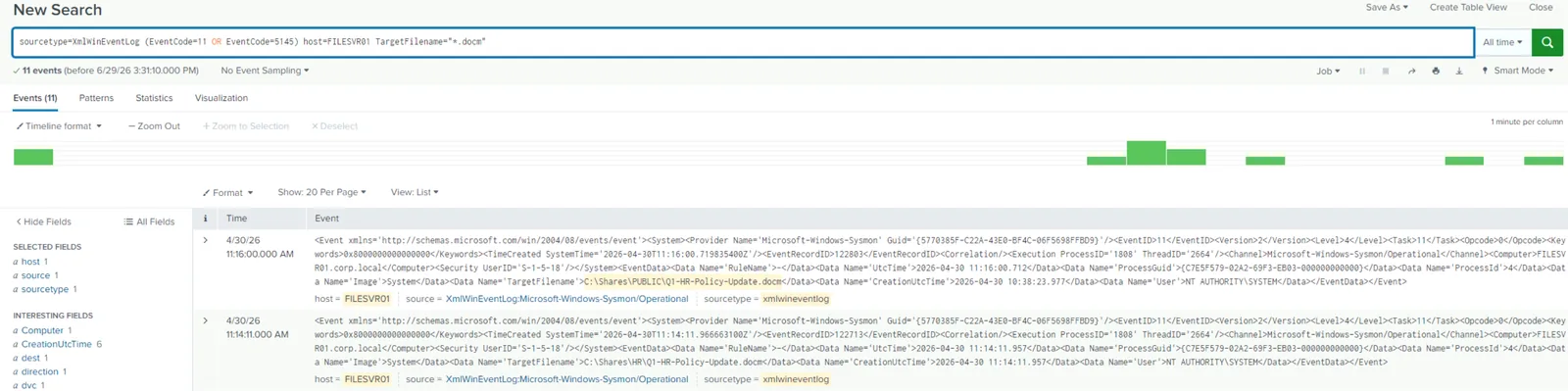
The net view sweep during recon flagged FILESVR01, and a write to its public share follows. Hunt the file-write directly with sourcetype=XmlWinEventLog (EventCode=11 OR EventCode=5145) host=FILESVR01 TargetFilename="*.docm". The macro-enabled .docm dropped on the PUBLIC share is an HR-themed lure — a spray-and-wait approach on an open share rather than a targeted mail, consistent with HR being the eventual victim.
Q7 — A user opened the staged phishing document, triggering a macro that dropped and executed a binary in the user’s profile. Provide the user, host, and full path of the dropped executable.
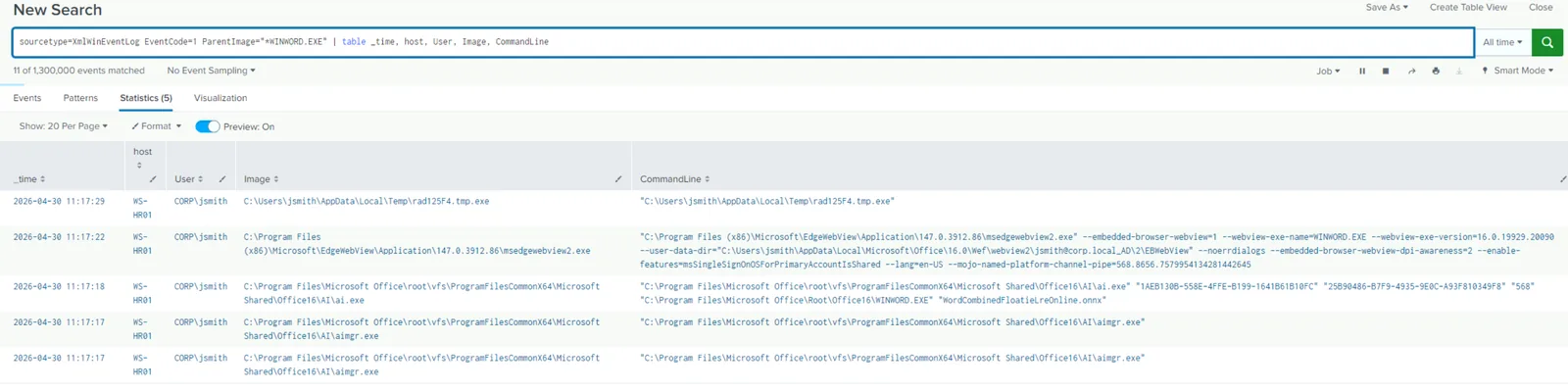
The macro spawns its payload directly from WINWORD.EXE, so filter for the abnormal child: sourcetype=XmlWinEventLog EventCode=1 ParentImage="*WINWORD.EXE" | table _time, host, User, Image, CommandLine. Skip the legitimate Office AI/telemetry children (aimgr.exe, ai.exe, msedgewebview2.exe) — the dropper is a single binary written straight to the user’s %TEMP% with a double-extension .tmp.exe disguise. Word spawns it directly with no shell intermediary, which is why a cmd/powershell-child filter comes back empty.
Tip: The
radXXXXXX.tmpprefix mimics Word’s AutoRecover temp-file convention — the macro chose it specifically to blend into normal Office artifacts during triage. The.tmp.exedouble extension is the tell.
Privilege Escalation
Q8 — From the foothold on the compromised workstation, the threat actor dropped and executed a privilege-escalation enumeration tool that was placed in the user’s profile directory. Identify the full file path.
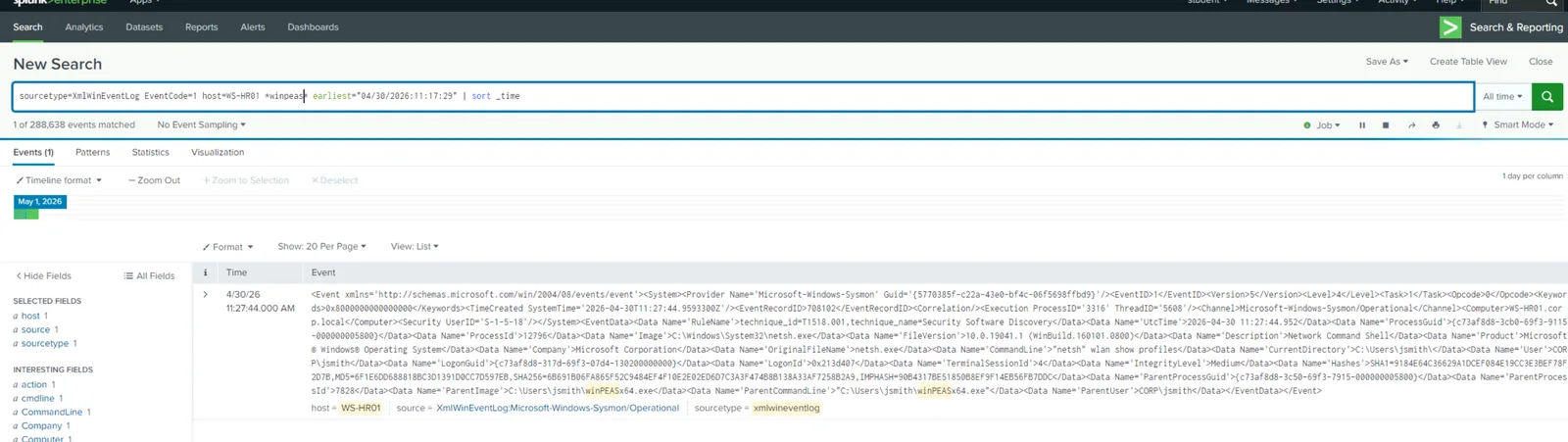
Continue the WS-HR01 process timeline forward from the dropper: sourcetype=XmlWinEventLog EventCode=1 host=WS-HR01 earliest="04/30/2026:11:17:29" | sort _time. The enumeration tool runs from the user profile root and immediately spawns netsh wlan show profiles — winPEAS’s saved-wifi-credential check, a reliable fingerprint of the tool kicking off its sweep.
Q9 — What DNS resolver did the host use during the download of the privilege escalation tool?
The winPEAS binary lands on disk as C:\Users\jsmith\winPEASx64.exe (FileCreate at the download moment, written by powershell.exe). The resolver used for that download isn’t the domain controller — a sweep of all external destinations from WS-HR01 (sourcetype=XmlWinEventLog EventCode=3 host=WS-HR01 NOT dest_ip="10.10.*" | stats count by dest_ip, dest_port) surfaces a public resolver on port 53. A domain-joined host querying Cloudflare directly instead of its internal DC is the anomaly — the attacker bypassed AD DNS for the fetch.

Tip: This question was edited mid-event to drop a reverse-FQDN second half — the keyed answer is just the resolver. The resolver is far easier to spot in the broad external-destination sweep than by trying to time-box the exact download connection.
Q10 — The enumeration tool flagged a writable service binary, which the attacker overwrote to obtain a SYSTEM shell. Provide the malicious binary path which dropped in the user’s profile to replace the service binary, and the original service path.
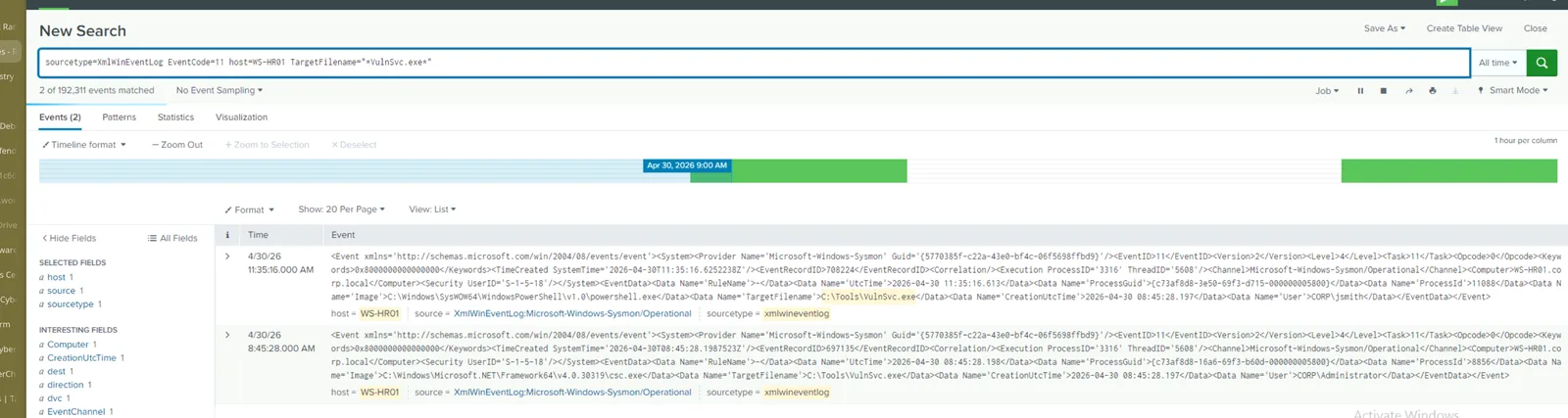
winPEAS flagged a writable service binary; the icacls C:\Tools\VulnSvc.exe write-permission check at 11:32:15 validates the finding by hand. The overwrite happens inside an interactive PowerShell session, so it leaves no process-creation trace — pivot to the FileCreate event for both the source and target: sourcetype=XmlWinEventLog EventCode=11 host=WS-HR01 TargetFilename="*VulnSvc.exe*". PowerShell writes the malicious binary into the user profile, then copies it over the legitimate service path; services.exe restarting the service then spawns the swapped binary as SYSTEM.
Credential Access
Q11 — With SYSTEM achieved, the attacker dumped LSASS memory and recovered a high-privilege domain account’s password in cleartext, then validated it via an inbound logon to the domain controller. What is the username?
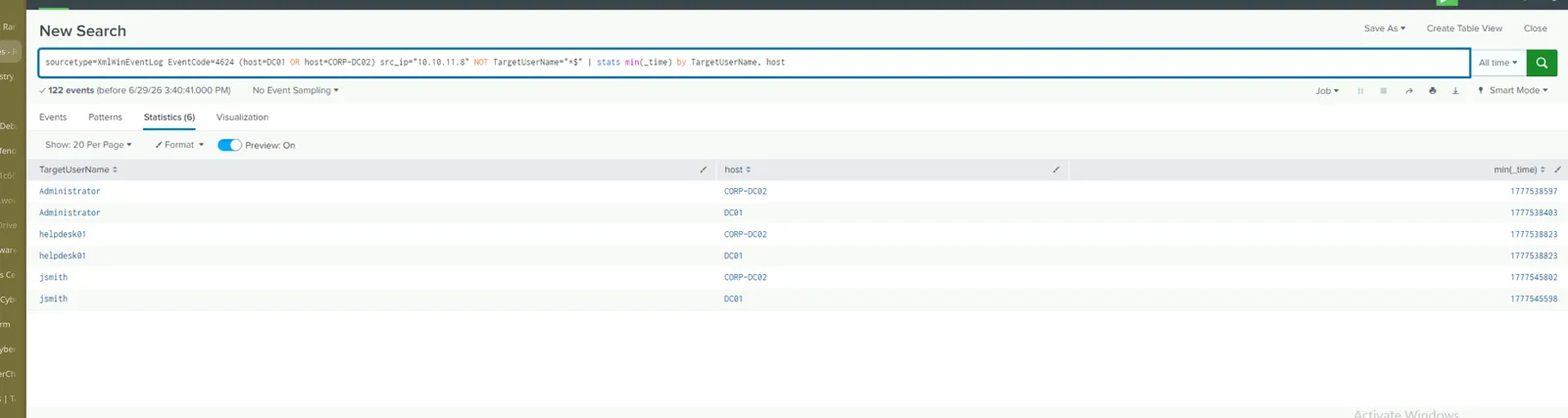
The SYSTEM-context binary accesses LSASS at 11:39:47 — confirmed via sourcetype=XmlWinEventLog EventCode=10 host=WS-HR01 TargetImage="*lsass.exe*", where the VulnSvc.exe row’s call trace terminates in an unbacked memory region (UNKNOWN(...)), the signature of a credential-dumping read rather than a legitimate module. The recovered account is then validated by an inbound logon to the DC sourced directly from the compromised workstation: sourcetype=XmlWinEventLog EventCode=4624 (host=DC01 OR host=CORP-DC02) src_ip="10.10.11.8" NOT TargetUserName="*$" | stats min(_time) by TargetUserName, host. The privileged account logging in from WS-HR01’s IP is the answer.
Gotcha: A privileged-sounding account also appears logging in from the Linux pivot (
10.10.5.37) shortly after the dump — it is a decoy. The actual LSASS-recovered credential validates from WS-HR01’s own IP (10.10.11.8), the host where the dump happened. Filtering on the pivot IP leads to the wrong account.
Q12 — Continuing credential-access activity, the attacker identified a domain account with Kerberos pre-authentication disabled. What is the username?
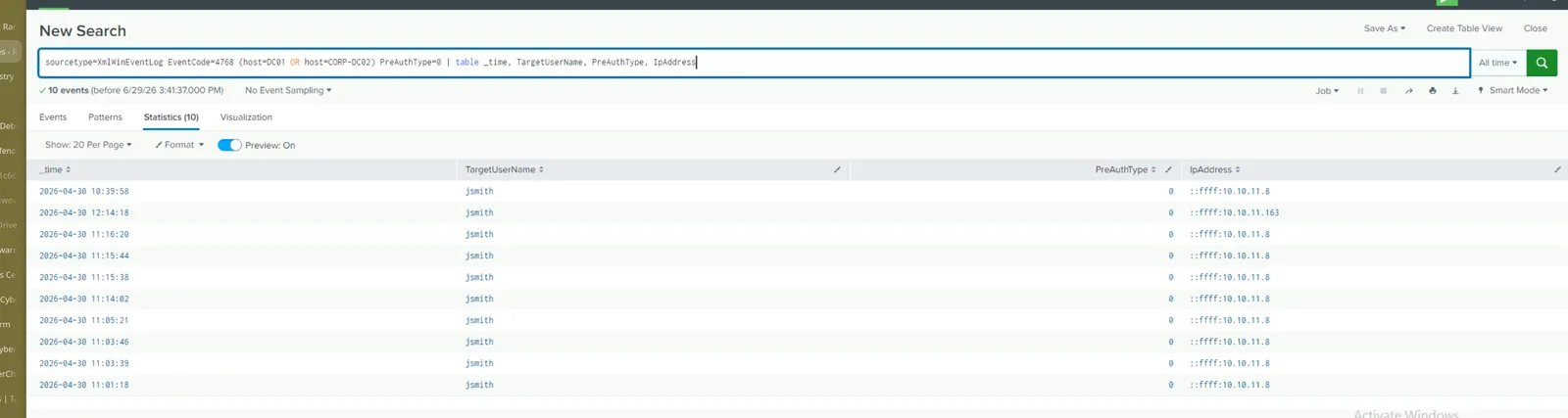
AS-REP roasting targets accounts with DONT_REQ_PREAUTH set, and the definitive artifact is a TGT request issued without pre-authentication. Filter sourcetype=XmlWinEventLog EventCode=4768 (host=DC01 OR host=CORP-DC02) PreAuthType=0 | table _time, TargetUserName, PreAuthType, IpAddress. One account returns across every event — and it is the phished HR user, whose account carries the pre-auth-disabled flag.
Tip: Filtering on
TicketEncryptionType=0x17(RC4) is misleading here — it catchesAdministratorRC4 fallbacks too.PreAuthType=0is the clean discriminator that isolates the AS-REP-roastable account.
Q13 — The attacker also harvested service tickets via Kerberoasting. Which three SPN-bearing service accounts were targeted?
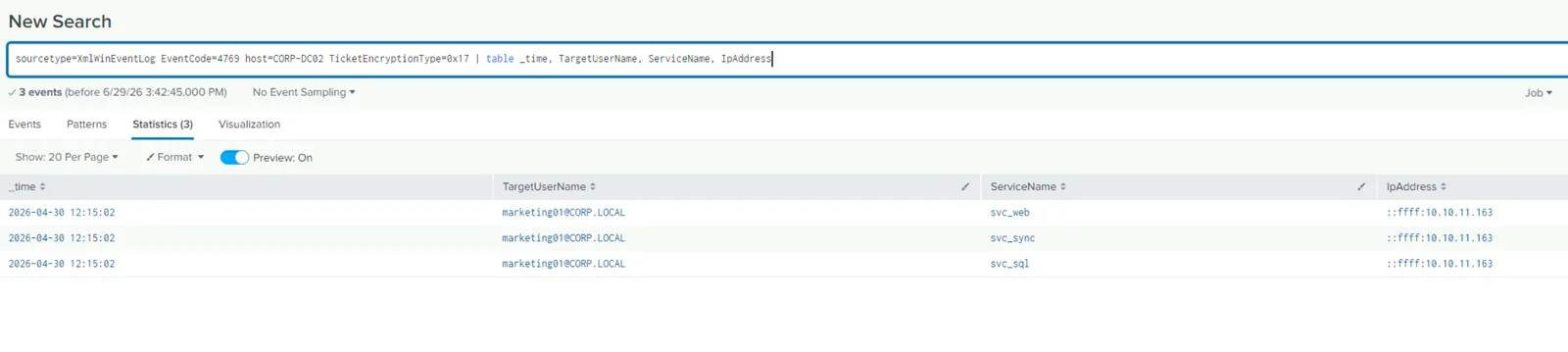
Kerberoasting requests RC4 service tickets so they can be cracked offline. The roasting burst here ran against the secondary DC, not DC01: sourcetype=XmlWinEventLog EventCode=4769 host=CORP-DC02 TicketEncryptionType=0x17 | table _time, TargetUserName, ServiceName, IpAddress. Three svc_* service-ticket requests fire in the same second from the beachhead — the classic single-tool roast of every SPN at once.
Tip: DC01’s 4769 logs are all
0x12(AES) — no RC4. The roasting was issued against CORP-DC02 specifically. Check both DCs when an encryption-type filter comes up empty on the primary.
Persistence
Q14 — While stabilizing SYSTEM access on the workstation after losing connection many times so fast, the attacker manipulated a legitimate process in memory before resuming it with altered behavior. What MITRE ATT&CK technique applies?
Manipulating a legitimate process in memory and resuming it with attacker code is the textbook definition of process hollowing — a suspended legitimate process whose image is replaced before execution resumes. The repeated fast reconnects described in the question point at an unstable shell being stabilized through injection rather than a fresh persistence mechanism.
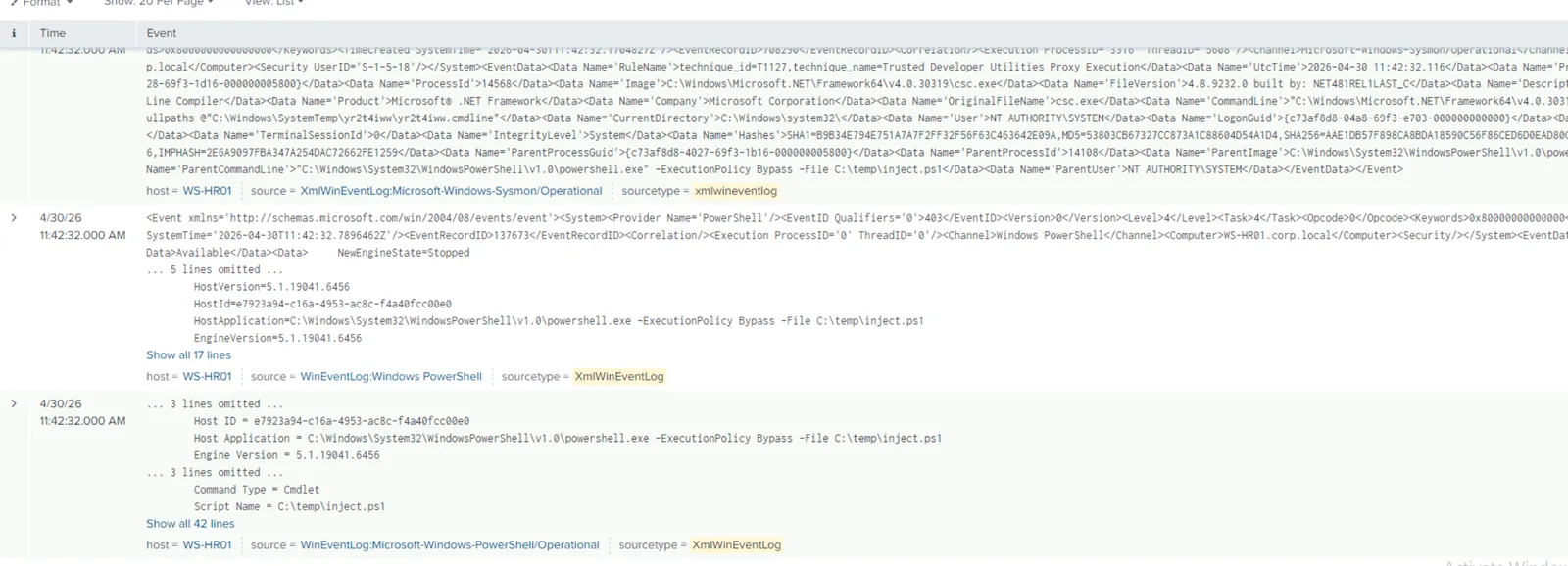
Q15 — In the same phase, when a more stable shell session was needed, an inject script was downloaded to allocated memory in a remote process and marked the region executable. Provide the Win32 protection constant variable and its hex value.
Allocating memory in a remote process and marking it executable to host injected shellcode is the canonical VirtualAllocEx/VirtualProtectEx pattern, and the protection constant that makes a region both writable and executable is the one to name. The C:\temp\inject.ps1 artifact written during this phase is the injection script itself.
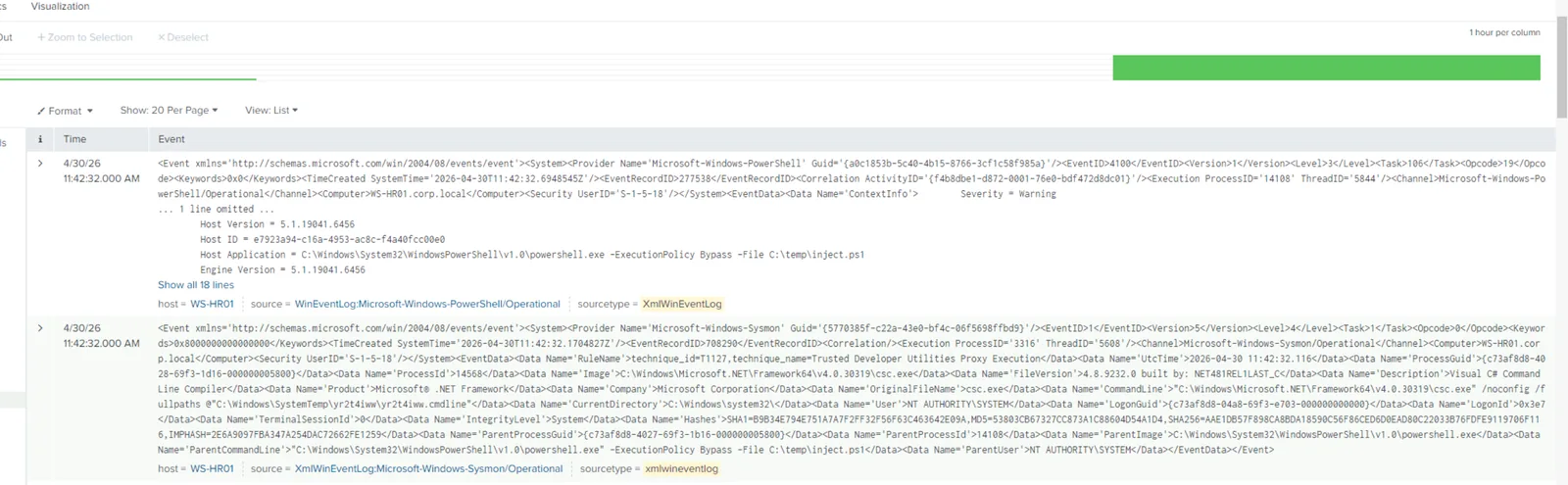
Tip: The constant is the read-write-execute protection flag — the single most common indicator of shellcode injection because it is almost never legitimately needed.
Q16 — Having reached the domain controller using high-privilege credentials harvested from LSASS, the attacker created some accounts; one is a typosquatted domain account and added it to Domain Admins. What is its sAMAccountName?
AD account creation and group changes are authoritative regardless of the tool used, so go straight to the security events rather than guessing command lines: sourcetype=XmlWinEventLog (EventCode=4720 OR EventCode=4728 OR EventCode=4732) host=DC01 | sort _time | table _time, EventCode, TargetUserName, MemberName. Three accounts are created in under three minutes; the typosquat is the one whose name reads like administrator with a single letter missing, added straight to Domain Admins.
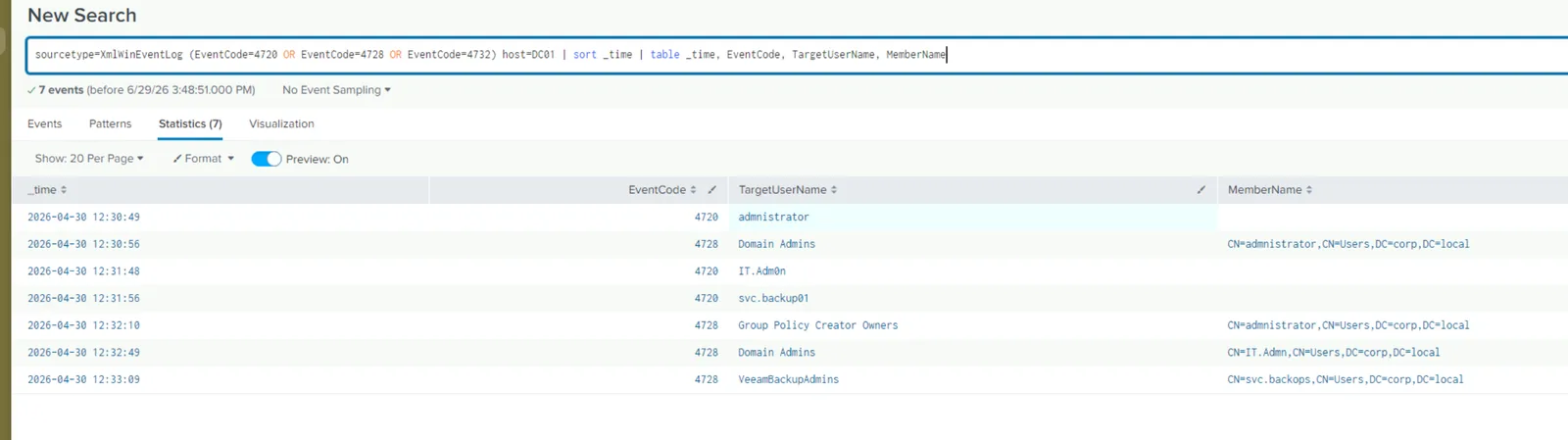
Tip: The actor created three accounts with three distinct purposes — a pure typosquat-DA, a fake IT-staff account also in Domain Admins, and a backup-service-flavored account added to a Veeam admin group. The question wants the typosquat specifically: the one that mimics the real built-in administrator by dropping a character.
Q17 — Alongside the lookalike account, a commercial remote-access tool was installed as a service on the corp.local DC for redundant access. What is the executable’s full image path?
RMM installers land on disk before the service registers, so hunt file writes on the DC in the post-account-creation window: sourcetype=XmlWinEventLog EventCode=11 host=DC01 TargetFilename="*AnyDesk*". The tool stages to C:\Windows\Temp, then installs to its standard ProgramData path with a Startup-folder shortcut — service plus startup persistence, redundant against reboot and against losing the original shell.

Cross-Forest Pivot
Q18 — Among the Kerberoasted service accounts, one had its password reused across forests. From the Linux pivot, the attacker successfully sprayed partner.local with this credential. Which account?
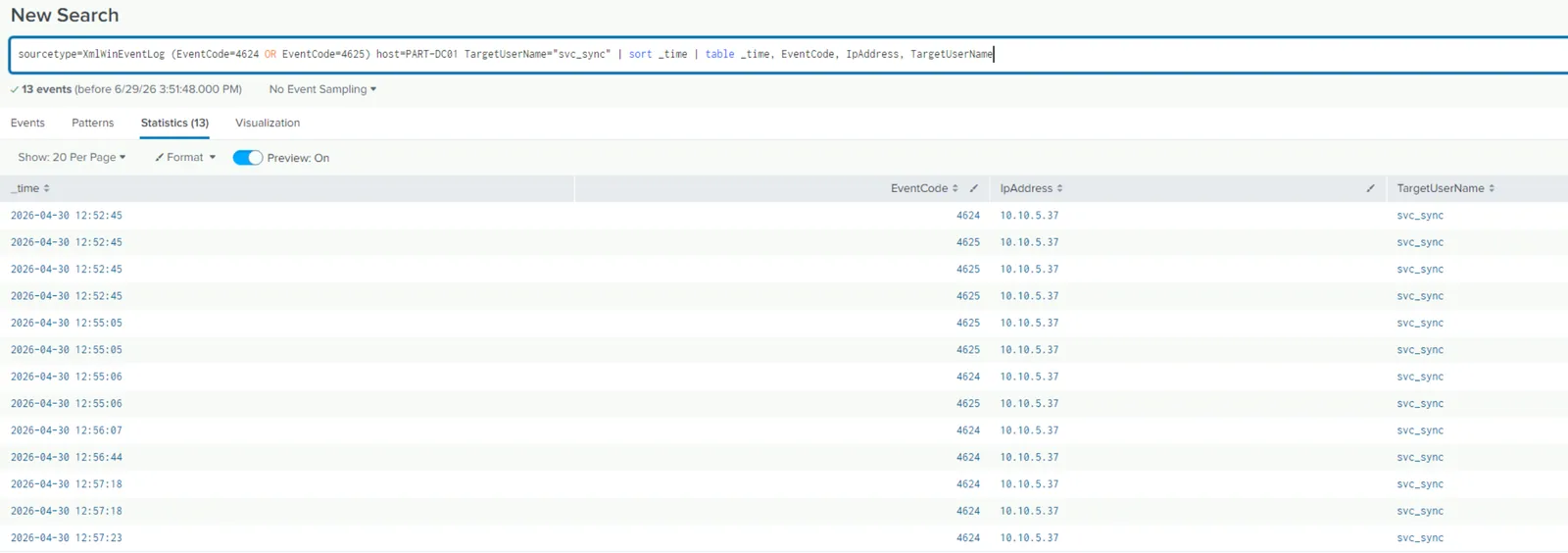
One of the three Kerberoasted service accounts (Q13) was cracked offline and its password reused across the trust. Confirm the spray landing on the partner DC: sourcetype=XmlWinEventLog (EventCode=4624 OR EventCode=4625) host=PART-DC01 TargetUserName="svc_sync" | sort _time | table _time, EventCode, IpAddress, TargetUserName. A cluster of failures from the Linux pivot resolves into a successful logon — the reused credential working against partner.local, the exact mechanism that later carried ransomware across the forest boundary.
Command and Control
Q19 — Across the entire intrusion, distinct destination ports were observed in C2 callbacks to the staging server: payload downloads, the initial macro-borne shell, the SYSTEM shell after privilege escalation. List them in that order.
Aggregating staging-server connections by source process makes the phase-to-port mapping unambiguous: sourcetype=XmlWinEventLog EventCode=3 dest_ip="52.58.62.68" | stats min(_time) as first_seen values(host) as hosts by Image, dest_port | sort first_seen | convert ctime(first_seen). The earliest powershell.exe callback on a 2-digit port is the payload download; the dropped macro binary (rad125F4.tmp.exe) opens the initial shell on its own port; the SYSTEM-context VulnSvc.exe opens the post-escalation shell on a third. Read them in the stated phase order, keyed by which process owns each connection.
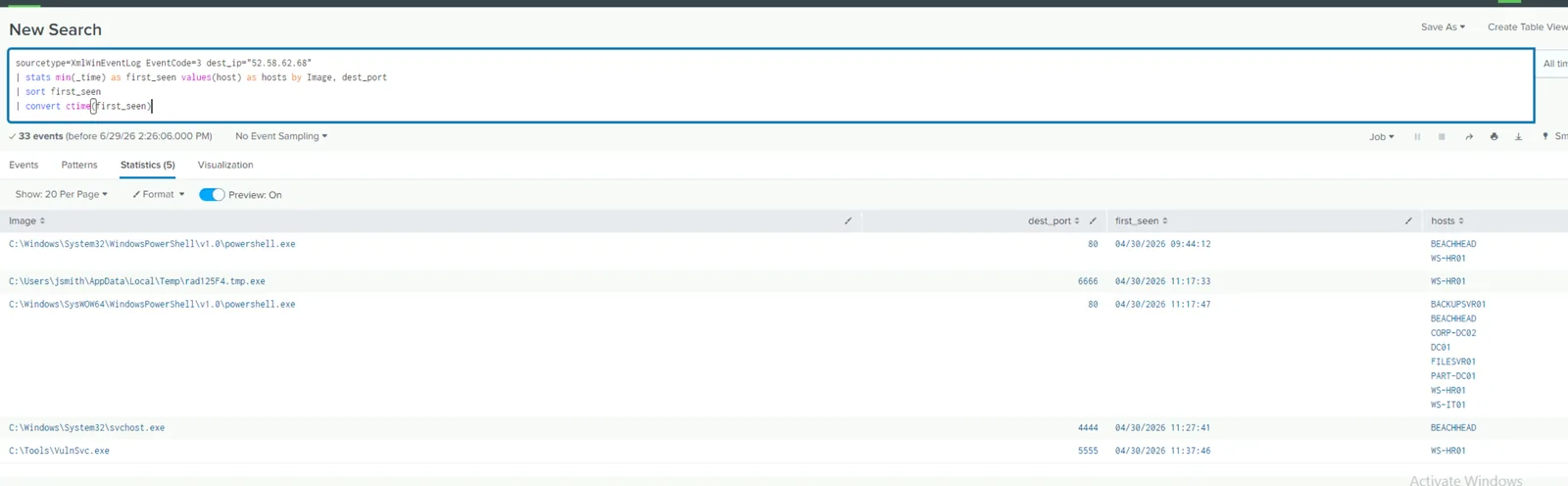
Gotcha: This question shipped with a stale 4-slot answer mask while naming only three phases, and was edited twice during the event. The correct answer is three ports. Ordering is by named phase, not strict chronology — the macro-shell port can appear later on a given host than the download port. Map each port to its owning process, not to its first timestamp.
Ransomware Deployment
Q20 — With cross-forest Domain Admin secured, the attacker mass-deployed the ransomware via repeated remote service creation with randomized names and execution from ADMIN$ across all reachable hosts. What framework and tool generated this behavior?
Repeated remote service creation with randomized names plus execution from the ADMIN$ share is the signature of Impacket’s psexec.py — the randomized service-name pattern distinguishes it from smbexec.py or native sc/PsExec. The deployment fans out from the DC across every reachable host in both forests.
Q21 — When was the ransomware binary first touched its first target? Give both the download start time and the deployment path. Provide both.
A cross-host sweep of the binary’s FileCreate events shows the deployment marching across both forests: sourcetype=XmlWinEventLog EventCode=11 TargetFilename="*lynx.exe*" | stats count by host, _time | sort _time. The earliest write lands on the beachhead — the first target touched — and every host receives the binary at the same C:\Windows\SysWOW64 path. The full deployment spans roughly 39 minutes end to end, reaching the partner-forest DC last and confirming the cross-forest pivot paid off.
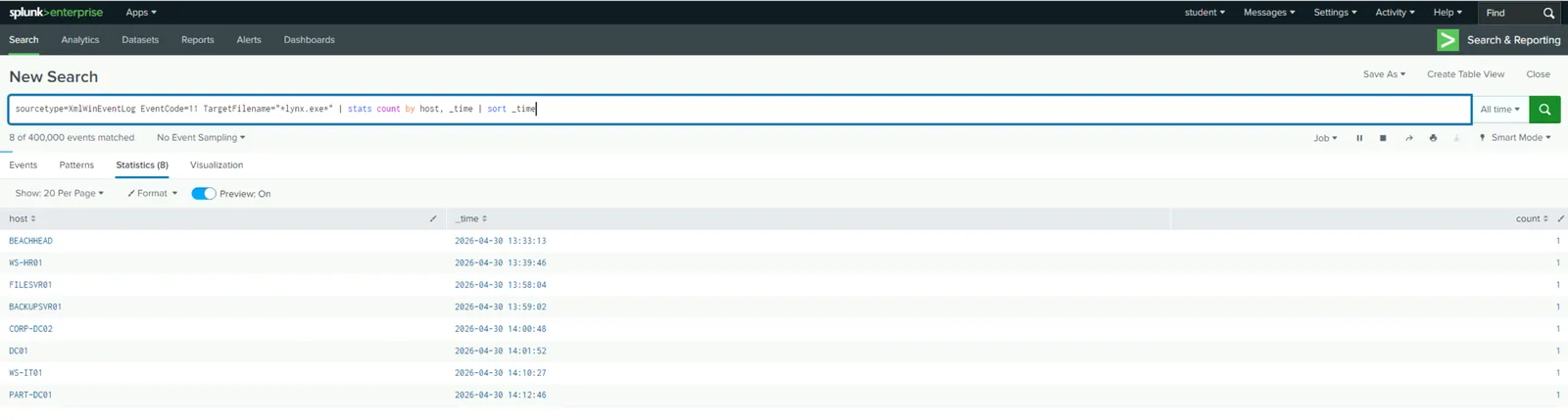
Gotcha: “First touched its first target” means the earliest write across the whole estate (the beachhead), not the DC. And the timestamp format truncates to minutes — drop the seconds, unlike the PE-properties question that wants full seconds.
Q22 — As part of the impact stage, the ransomware drops a desktop wallpaper image to deface victims. What is its full path?
Lynx’s wallpaper defacement writes a known image to the temp directory and points HKCU\Control Panel\Desktop\Wallpaper at it. The path is recoverable from the binary’s own strings or from the FileCreate during the impact phase — it matches the documented Lynx behaviour exactly.

Static Malware Analysis
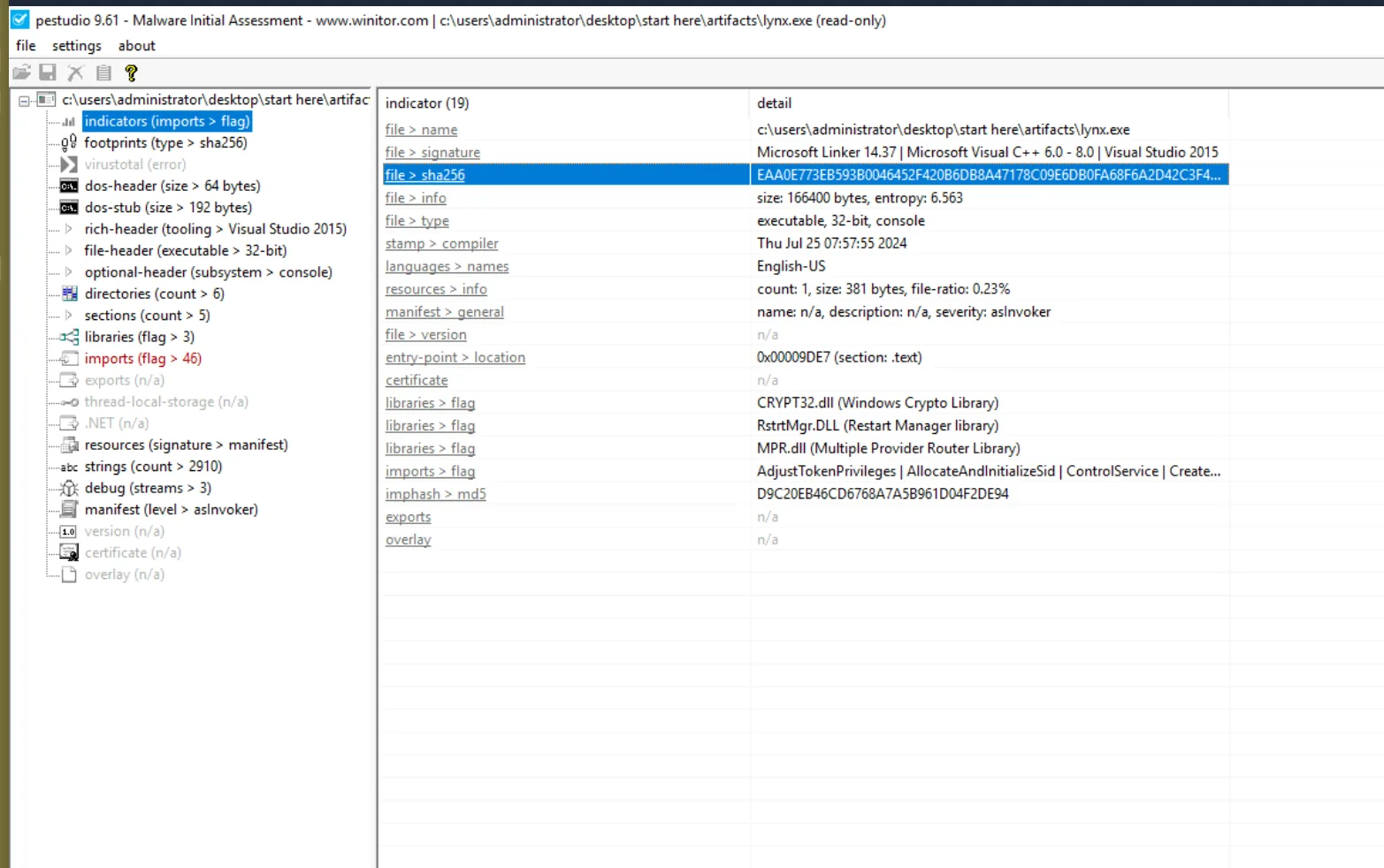
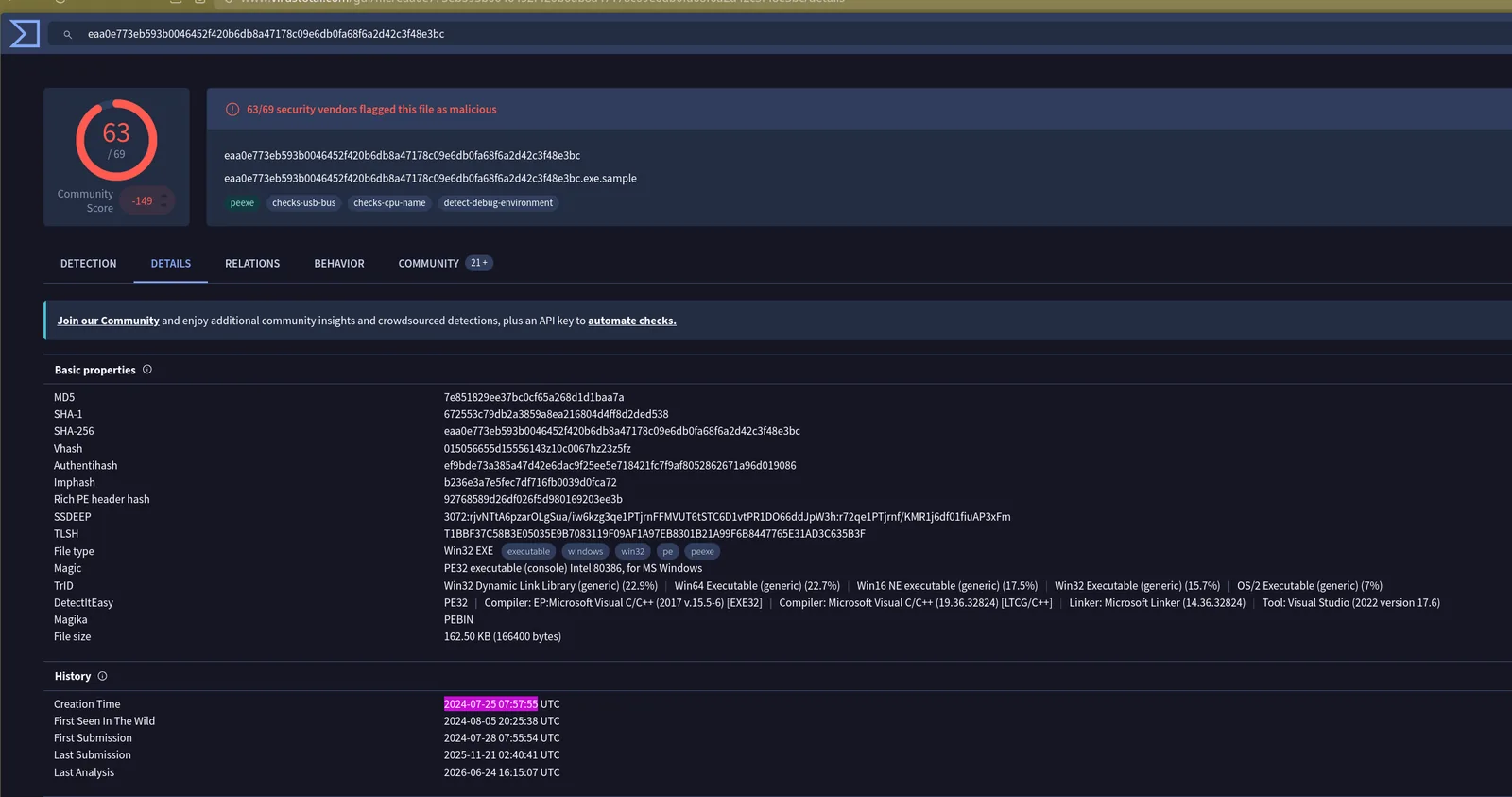
Q23 — A copy of the ransomware binary was recovered post-incident. From its basic file properties, provide the SHA256 hash and the PE compilation timestamp (UTC).
DIE confirms the binary as a 32-bit console PE32 built with MSVC 2022; PEStudio’s footprint pane carries the SHA256. The compilation timestamp is the catch — this hash matches the authentic mid-2024 Lynx sample, so the keyed compile time aligns with the VirusTotal-reported value rather than a raw header decode.
Gotcha: The File Header
TimeDateStamp(66A20583) decodes to2024-07-25 17:04:03, but the keyed answer is the VirusTotal-reported compile time2024-07-25 07:57:55— which also matches the RSDS debug-stream stamp seen in PEStudio’s debug node, not the File Header. Two “compilation timestamps” disagree; the debug-stream/VT one is correct.
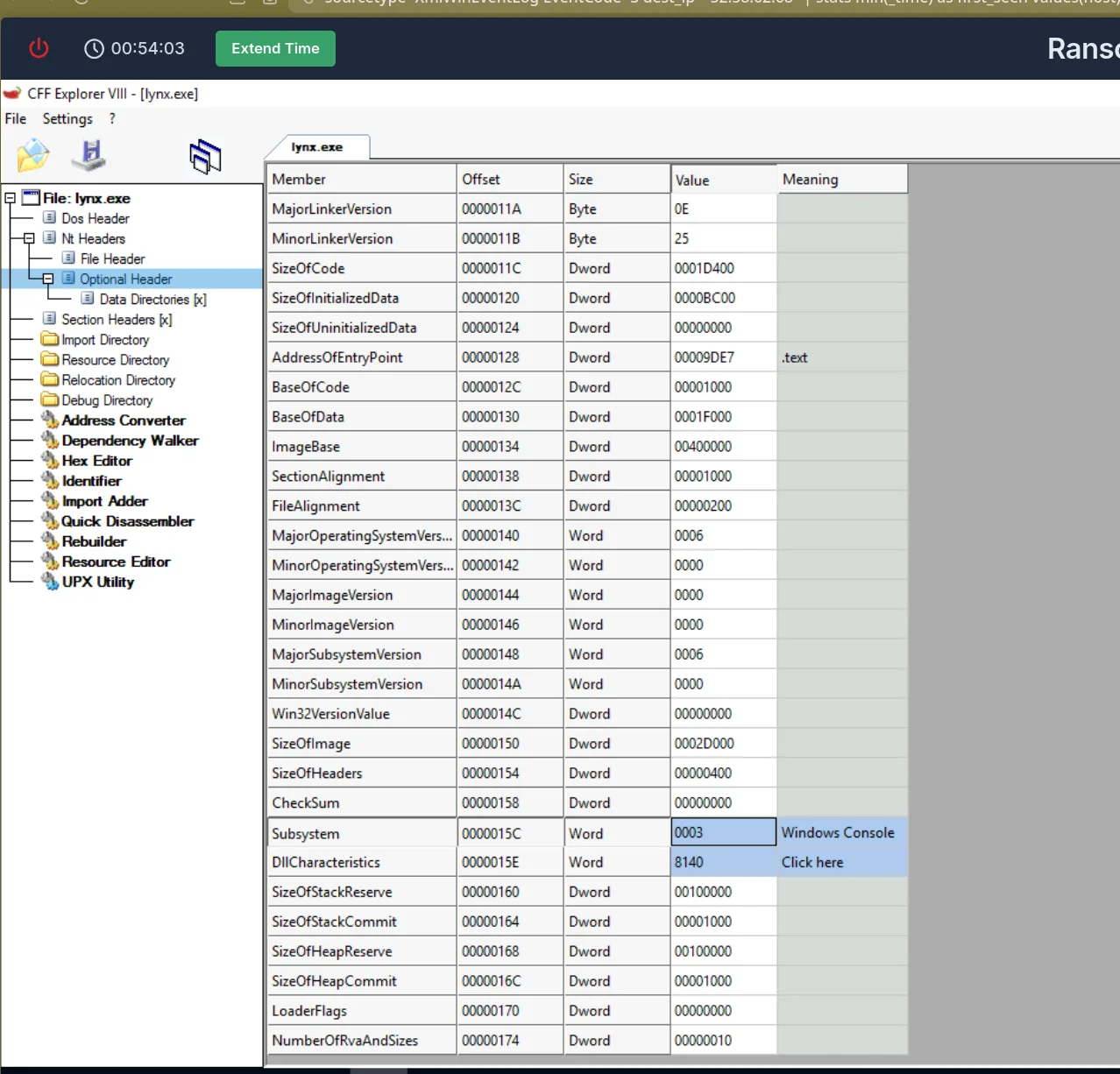
Q24 — Per the PE Optional Header, what is the binary’s subsystem constant (per MSDN)?
DIE and CFF Explorer both report the binary as a console application. The MSDN subsystem constant for a console-mode image is the answer — consistent with a command-line-driven ransomware locker that takes runtime arguments.
Q25 — What PDB path is embedded in the PE Debug directory?
The Debug directory carries a PDB 7.0 (RSDS) entry. PEStudio’s debug node renders the embedded path string cleanly under debug > file — CFF Explorer’s Debug Directory view shows the structure but not the string itself. The path exposes the developer’s build environment: a Release build of a project named for the family, off the dev machine’s E: drive.
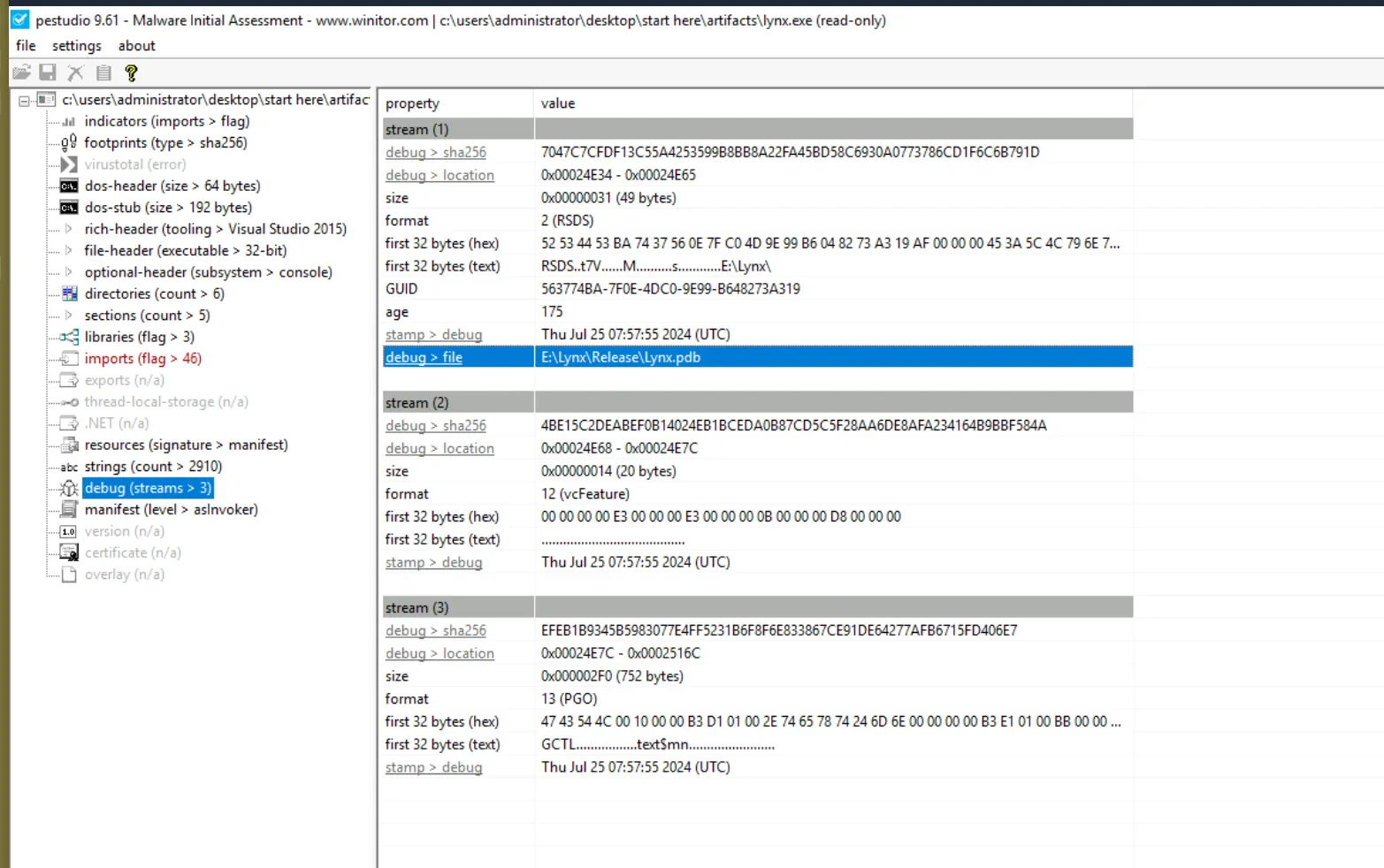
Tip: CFF Explorer’s Debug Directory only shows the directory entry’s offsets and type (CodeView). To read the actual PDB string, use PEStudio’s debug node or follow
PointerToRawDatain a hex editor.
Q26 — Three of the binary’s imported DLLs are flagged as highly suspicious by static analysis. Name them.
PEStudio’s libraries view colour-codes blacklisted imports, and the flagging is the answer directly. Three DLLs carry the suspicious flag, and they map cleanly onto Lynx’s behaviour: the crypto library for AES/Curve25519, the Restart Manager library for unlocking in-use files during encryption, and the Multiple Provider Router for enumerating and encrypting network shares — a textbook ransomware import triad.
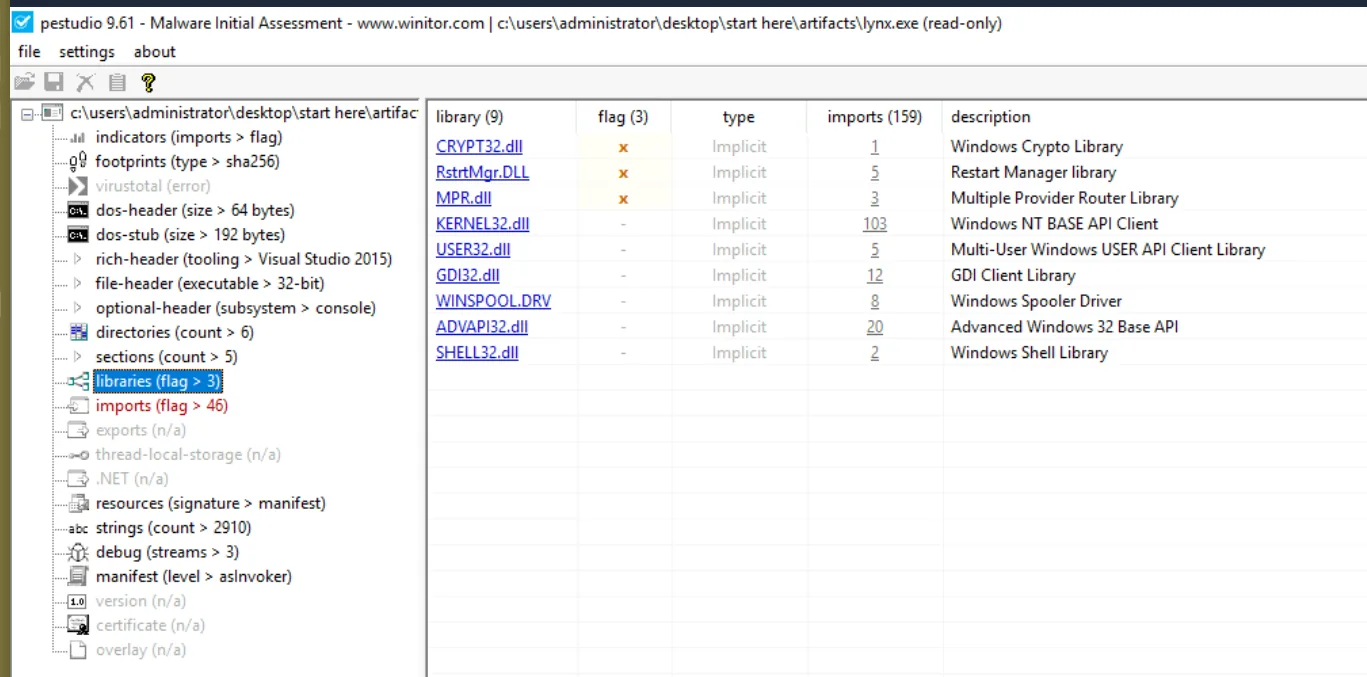
Tip: Don’t reason about which imports “feel” suspicious — PEStudio’s flag column is exactly what the question is keyed to. Read the three flagged entries verbatim.
Q27 — Inside the note-builder, one helper function decodes the embedded ransom-note blob. What is its IDA auto-name?
The ransom note is stored as a base64 blob in .rdata, with a single code cross-reference from _main. Jump to that xref and the note-builder pushes the blob as an argument alongside a pcbBinary out-parameter — the giveaway for a CryptStringToBinary decode — then calls the helper. That call target is the note-decode function; IDA’s auto-name for it is the answer.
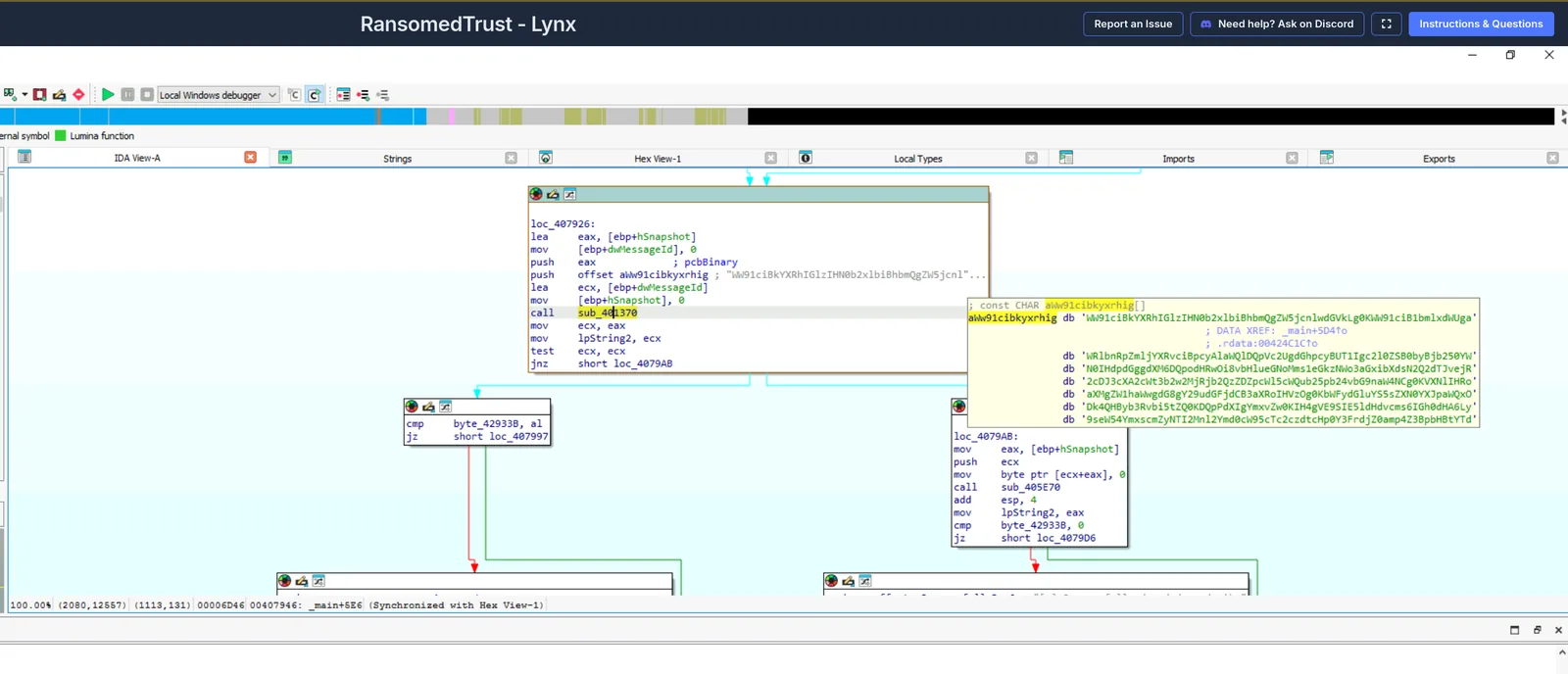
Tip: The
pcbBinaryargument label is the confirmation — that out-parameter name belongs toCryptStringToBinaryA, so the function consuming the base64 blob with that signature is the decoder, not the later note-writing call in the adjacent block.
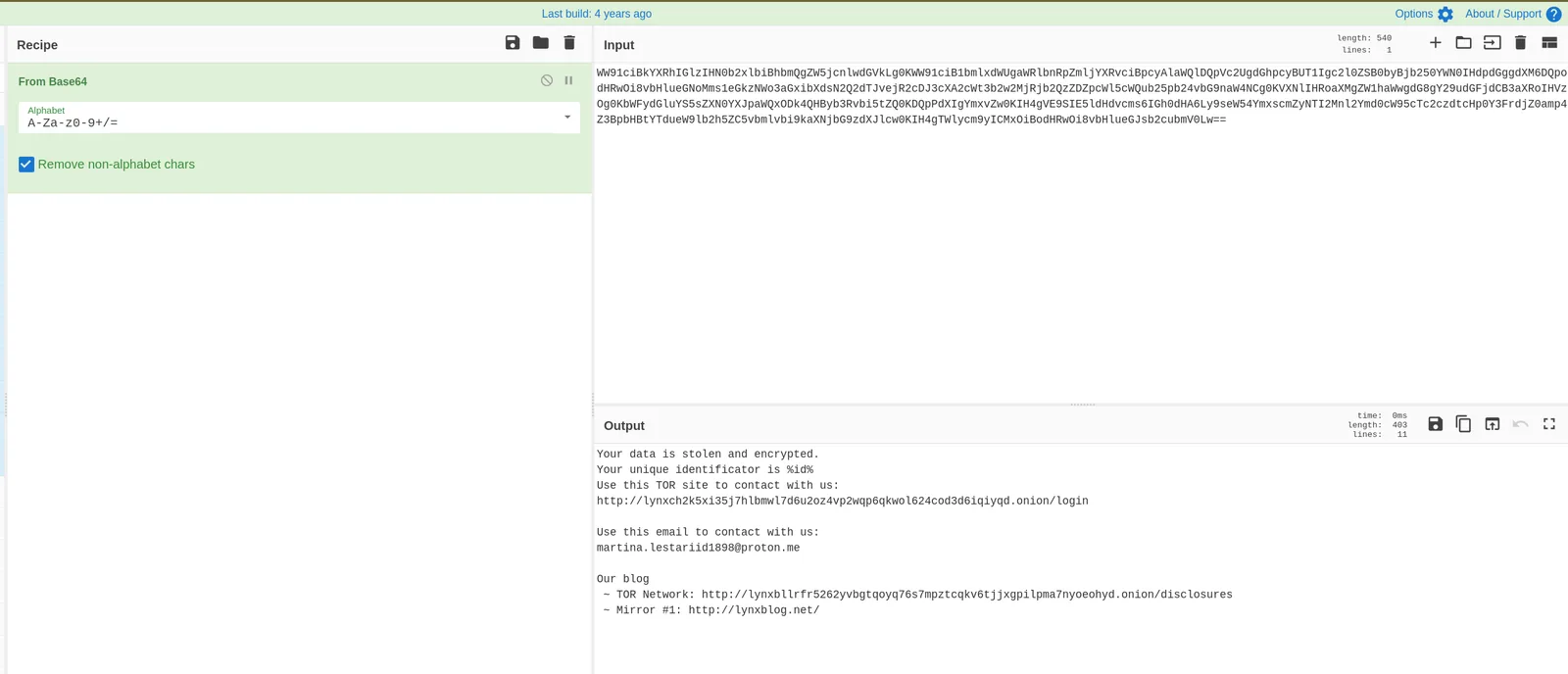
Q28 — What .onion URL is embedded in the ransom note?
The base64 note blob recovered in Q27 decodes straight to the ransom text. Drop it into CyberChef with a From Base64 operation and the contact line resolves to the Lynx negotiation portal. The decoded note also carries a blog mirror and a proton contact email — good IOC-table material — but the question wants the /login contact portal.
Q29 — The ransomware skips four file extensions during encryption. List them.
The skip-list lives in .rdata as UTF-16LE strings near the directory-enumeration logic, alongside the process/service kill-list (sql, veeam, backup, exchange). Filter IDA’s strings window for the family extension and the four skipped types cluster together — the binary avoids re-encrypting its own dropped components and the installers it needs.
Gotcha: The extensions are stored as UTF-16LE (Unicode), which is why an ASCII-only strings scan in PEStudio misses them. IDA’s strings window shows Unicode by default; the kill-list strings in the same neighbourhood confirm you’re in the right wide-string region.
Attack Summary
| Phase | Action |
|---|---|
| Initial Access | LLMNR/NBT-NS poisoning from a dual-homed, unmonitored Linux dev server harvested marketing01; used to RDP onto the internet-exposed beachhead |
| Discovery | nltest /domain_trusts enumerated the forest trust; SharpHound collected AD objects into a timestamped zip in C:\Windows\Temp |
| Exfiltration | AD-collection archive pushed to an external SMB share with plaintext credentials on the command line |
| Phishing | Macro-enabled .docm lure dropped on the FILESVR01 PUBLIC share |
| Execution | HR user jsmith opened the document; macro dropped and ran a .tmp.exe payload from %TEMP% on WS-HR01 |
| Privilege Escalation | winPEAS flagged a writable service binary; attacker overwrote it from the user profile and restarted the service to land SYSTEM |
| Credential Access | LSASS dumped to recover helpdesk01; AS-REP-roastable jsmith identified; svc_web/svc_sync/svc_sql Kerberoasted via RC4 on CORP-DC02 |
| Persistence | Process-hollowing injection to stabilize the shell; lookalike DA admnistrator created; AnyDesk installed as a service on DC01 |
| Cross-Forest Pivot | Cracked svc_sync password sprayed from the Linux pivot into partner.local |
| Command and Control | Staging-server callbacks on three ports for download, macro shell, and SYSTEM shell |
| Impact | Lynx mass-deployed via Impacket psexec.py over ADMIN$ to eight hosts across both forests; wallpaper defacement and ransom notes dropped |
IOCs
| Type | Value |
|---|---|
| Staging server / C2 | 52[.]58[.]62[.]68 |
| Linux pivot (internal) | 10.10.5.37 |
| External DNS resolver abused | 1[.]1[.]1[.]1 |
| Leaked credential | b4l3ri0n:Password123 |
| Compromised foothold account | marketing01 |
| Phishing lure | C:\Shares\PUBLIC\Q1-HR-Policy-Update.docm |
| Dropped payload | C:\Users\jsmith\AppData\Local\Temp\rad125F4.tmp.exe |
| Privesc tool | C:\Users\jsmith\winPEASx64.exe |
| Service-hijack binary | C:\Users\jsmith\vulnsvc_system.exe → C:\Tools\VulnSvc.exe |
| Injection script | C:\temp\inject.ps1 |
| Lookalike DA accounts | admnistrator, IT.Adm0n, svc.backup01 |
| RMM persistence | C:\ProgramData\AnyDesk\AnyDesk.exe |
| Ransomware deployment path | C:\Windows\SysWOW64\lynx.exe |
| Wallpaper defacement | C:\Windows\Temp\background-image.jpg |
| Ransomware SHA256 | eaa0e773eb593b0046452f420b6db8a47178c09e6db0fa68f6a2d42c3f48e3bc |
| PDB path | E:\Lynx\Release\Lynx.pdb |
| Ransom-note portal | hxxp[://]lynxch2k5xi35j7hlbmwl7d6u2oz4vp2wqp6qkwol624cod3d6iqiyqd[.]onion/login |
| Blog mirror | hxxp[://]lynxblllrfr5262yvbgtqoyq76s7mpztcqkv6tjjxgpilpma7nyoeohyd[.]onion/disclosures |
| Public blog | lynxblog[.]net |
| Contact email | martina[.]lestariid1898@proton[.]me |
MITRE ATT&CK
| Technique | ID | Description |
|---|---|---|
| LLMNR/NBT-NS Poisoning and SMB Relay | T1557.001 | Poisoning from the Linux pivot harvested marketing01 |
| Domain Trust Discovery | T1482 | nltest /domain_trusts mapped the corp.local ↔ partner.local trust |
| Account Discovery: Domain Account | T1087.002 | SharpHound + manual net enumeration of users, groups, and DAs |
| Phishing: Spearphishing Attachment | T1566.001 | Macro .docm staged on a public file share |
| User Execution: Malicious File | T1204.002 | HR user opened the lure, triggering the dropper |
| Command and Scripting Interpreter: PowerShell | T1059.001 | Encoded PowerShell shells and the privesc/injection chain |
| Hijack Execution Flow: Services File Permissions Weakness | T1574.010 | Writable service binary overwritten to gain SYSTEM |
| OS Credential Dumping: LSASS Memory | T1003.001 | SYSTEM-context binary read LSASS to recover helpdesk01 |
| Steal or Forge Kerberos Tickets: AS-REP Roasting | T1558.004 | jsmith identified with pre-auth disabled |
| Steal or Forge Kerberos Tickets: Kerberoasting | T1558.003 | RC4 service tickets requested for three svc_* accounts |
| Process Injection: Process Hollowing | T1055.012 | Legitimate process hollowed to stabilize the shell |
| Create Account: Domain Account | T1136.002 | Lookalike DA and service accounts created on DC01 |
| Remote Access Software | T1219 | AnyDesk installed as a service for redundant access |
| Remote Services: SMB/Windows Admin Shares | T1021.002 | Ransomware pushed over ADMIN$ during deployment |
| Brute Force: Password Spraying | T1110.003 | Reused svc_sync credential sprayed into partner.local |
| Non-Standard Port | T1571 | C2 callbacks on multiple high ports to the staging server |
| Exfiltration Over Alternative Protocol | T1048 | AD archive pushed to an external SMB share |
| Data Encrypted for Impact | T1486 | Lynx encryption across both forests |
| Inhibit System Recovery | T1490 | Lynx shadow-copy deletion as part of impact |
Defender Takeaways
An unmanaged, dual-homed host outside the SIEM is a complete blind spot, not a low-priority asset. The entire intrusion was launched from a forgotten Linux dev server that bridged the internet and the internal network while generating zero telemetry of its own. Every internal action only became visible once it touched a monitored Windows host. Asset inventory has to include the boxes nobody remembers, and any host with two NICs straddling trust boundaries needs either decommissioning or in-scope monitoring before it becomes the pivot.
The jump box was the single sanctioned interactive source, which makes any other interactive logon a high-fidelity alert. The first malicious RDP into the beachhead came from 10.10.5.37, not the gateway at 10.10.6.205. A simple detection — remote-interactive (Type 10) logons whose source is anything other than the jump box — would have fired on the very first hands-on action. Where a known-good administrative path exists, alert on deviations from it rather than trying to enumerate every bad source.
Missing PowerShell Script Block Logging forced the investigation onto FileCreate evidence, and that gap is the lesson. The service-binary overwrite and the cracked-credential reuse happened inside interactive PowerShell sessions that left no command-line trace, because 4104 logging was disabled. Sysmon FileCreate salvaged the reconstruction, but only because file-level telemetry existed. Enabling Script Block Logging (and Module Logging) closes the exact visibility hole this intrusion exploited at three separate phases.
A reused service-account password turned a single-forest compromise into a two-forest catastrophe. svc_sync was Kerberoasted on the corp.local side, cracked offline, and the identical password sprayed straight into partner.local — ransomware crossed the trust boundary because one credential did. Service accounts with SPNs must use long, random, regularly-rotated passwords (or gMSAs), and credentials must never be shared across a forest trust. Monitoring RC4 (0x17) ticket requests would also have surfaced the roasting burst in real time.
Writable service binaries and lookalike admin accounts are cheap to find and cheap to detect. winPEAS located the vulnerable service in seconds, and the same icacls/permission checks belong in routine hardening sweeps before an attacker runs them. On the persistence side, the typosquatted admnistrator and IT.Adm0n accounts were added to Domain Admins minutes after creation — alerting on 4720 (account creation) immediately followed by 4728/4732 (privileged-group addition), especially for names within an edit-distance of existing privileged accounts, catches exactly this pattern.
Conclusion
A forgotten Linux box with two network cards undid two entire forests. The affiliate never needed a novel exploit — they needed one unmonitored pivot, one reused service-account password, and a trust relationship nobody treated as an attack surface. The deployment binary was a stock mid-2024 Lynx sample; the damage lived entirely in the environment’s blind spots and shared credentials, not in the malware.