The Recurring Impostor — Flash Hunt
Case Context
A Flash Hunt on Threat Hunting Labs — the platform’s rapid, single-session investigation format, distinct from the guided multi-hour cases.
Threat Hunting Labs has a strict no-public-writeup policy on active labs to protect scoring and leaderboards for other users, so this page is intentionally an overview: what I did and what I found, not the queries or the specific answers that got me there.
A Windows workstation alert on a scheduled task with a suspicious target path traced back three levels to the real point of execution, then forward through a recurring persistence mechanism disguised as a legitimate system process, a Severe antivirus detection that was logged as resolved but never actually removed the payload, a destructive lockout stage two days later, and a masqueraded re-execution on day three. Enrichment against the attacker’s own external infrastructure recovered an exposed staging server, cross-confirming the toolkit and clearing up conflicting malware-family labels across four different sources.
Techniques Encountered
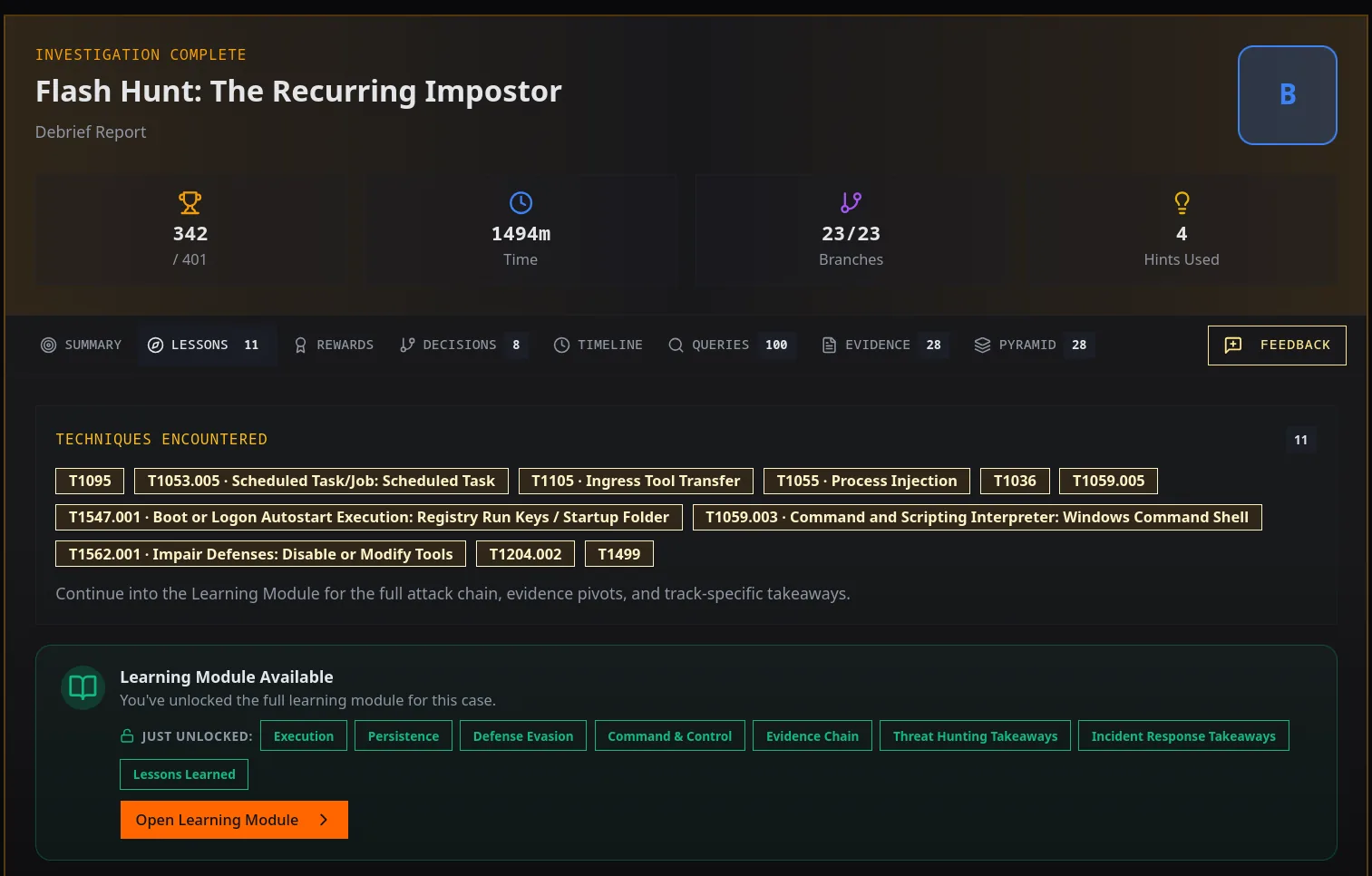
Eleven MITRE ATT&CK techniques surfaced during the hunt, spanning execution, scheduled-task and autostart persistence, masquerading, defense evasion, and command-and-control:
Prioritising Findings — Pyramid of Pain
28 findings came out of the hunt, weighted by how costly each is for the attacker to change — hash values and IP addresses sit at the bottom and are trivial to rotate, while the TTPs and tooling behind the persistence mechanism sit at the top and are far more durable to detect on:

What I Practiced
- Anchoring an investigation on the true root process rather than the alert’s stated “root,” which sat three process-tree levels below where execution actually began
- Correlating a Severe antivirus detection against its paired remediation-outcome event to recognize a failed cleanup logged as resolved, rather than taking the initial detection at face value
- Treating an EDR rule label (e.g. a process-injection tag on a handle-access event) as a hypothesis to verify against the underlying call-stack evidence, not as a confirmed finding
- Reconciling four independently-labeled malware family names for the same binaries across AV, an external threat-intel platform’s report, its file tags, and its catalog, and identifying why a platform’s UI search silently failed to surface the right one
- Ranking findings on the Pyramid of Pain to separate durable, behavior-based detection logic from indicators that change with the next build
Credential
Earned a Distinction (85% score) on this Flash Hunt.
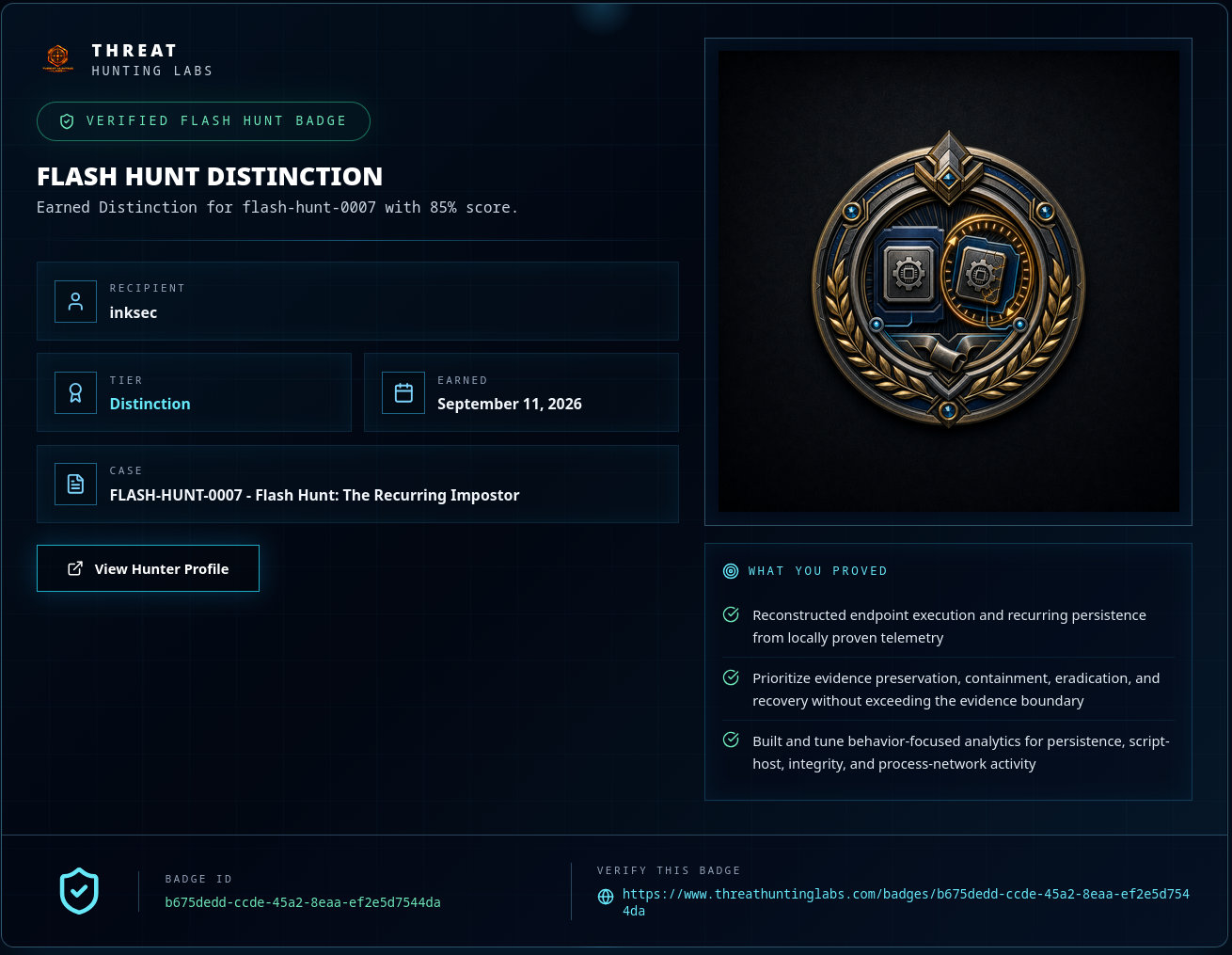
Verify: https://www.threathuntinglabs.com/badges/b675dedd-ccde-45a2-8eaa-ef2e5d7544da